


What Stays Manual Belongs In The Business Case
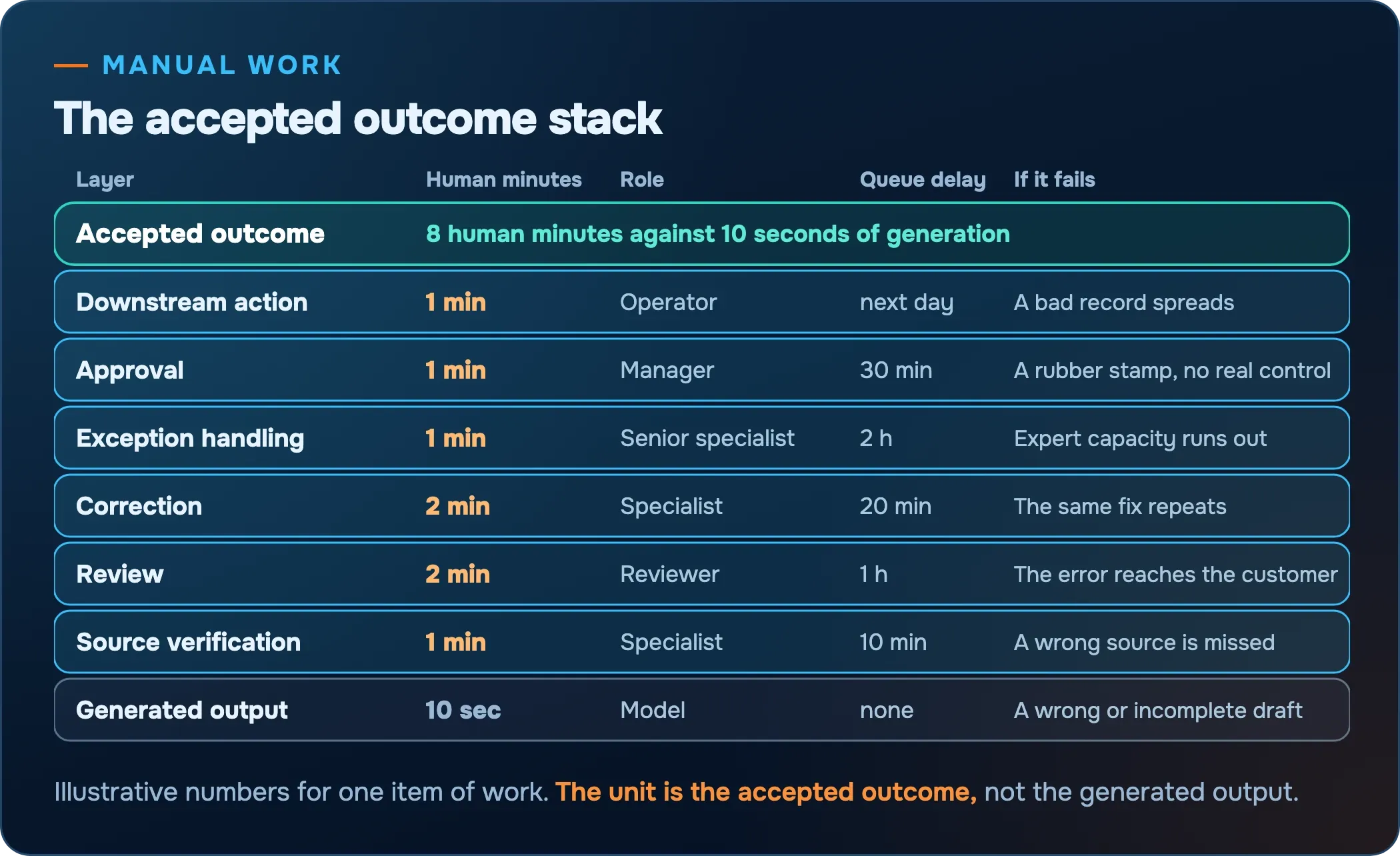
An AI workflow can produce an output in ten seconds and still take eight minutes to finish.
A specialist checks the source, corrects a category, confirms the recipient, resolves an exception, and repairs a downstream record. The dashboard sees one fast generation. The business absorbs the rest of the work across several people and systems.
That is how automation can look efficient before the organization tries to scale it.
The business case often counts model cost, generated output, and the time apparently saved by removing one visible task. It leaves out data preparation, review, approvals, exceptions, corrections, escalation, monitoring, and cleanup. Because this work is distributed, it does not appear as a single cost line. It survives as interruption, expert attention, queue delay, or founder rescue.
What stays manual belongs in the business case.
Measure the accepted outcome
The first correction is to define the unit of value.
A generated email is not automatically a useful email. A suggested CRM update is not an updated record. A summarized call is not a decision-ready account state. An extracted field is not a resolved case.
The useful unit is the accepted outcome: the approved CRM update, accepted draft, completed handoff, resolved case, or decision-ready brief. Generation is an intermediate event. The work required to move from output to accepted outcome is part of the system.
This distinction changes the denominator. A workflow that generates 1,000 items but produces 600 accepted outcomes has different economics from one that generates 700 and produces 650 accepted outcomes. The second system may appear less productive by volume while creating more usable work per unit of human attention.
It also changes what the team improves. If the bottleneck is review, making generation faster will not create much value. If the bottleneck is missing source data, a better prompt will not remove the preparation cost. If the bottleneck is a high-severity exception, average processing time may hide the expert capacity that constrains scale.
Not all manual work is waste
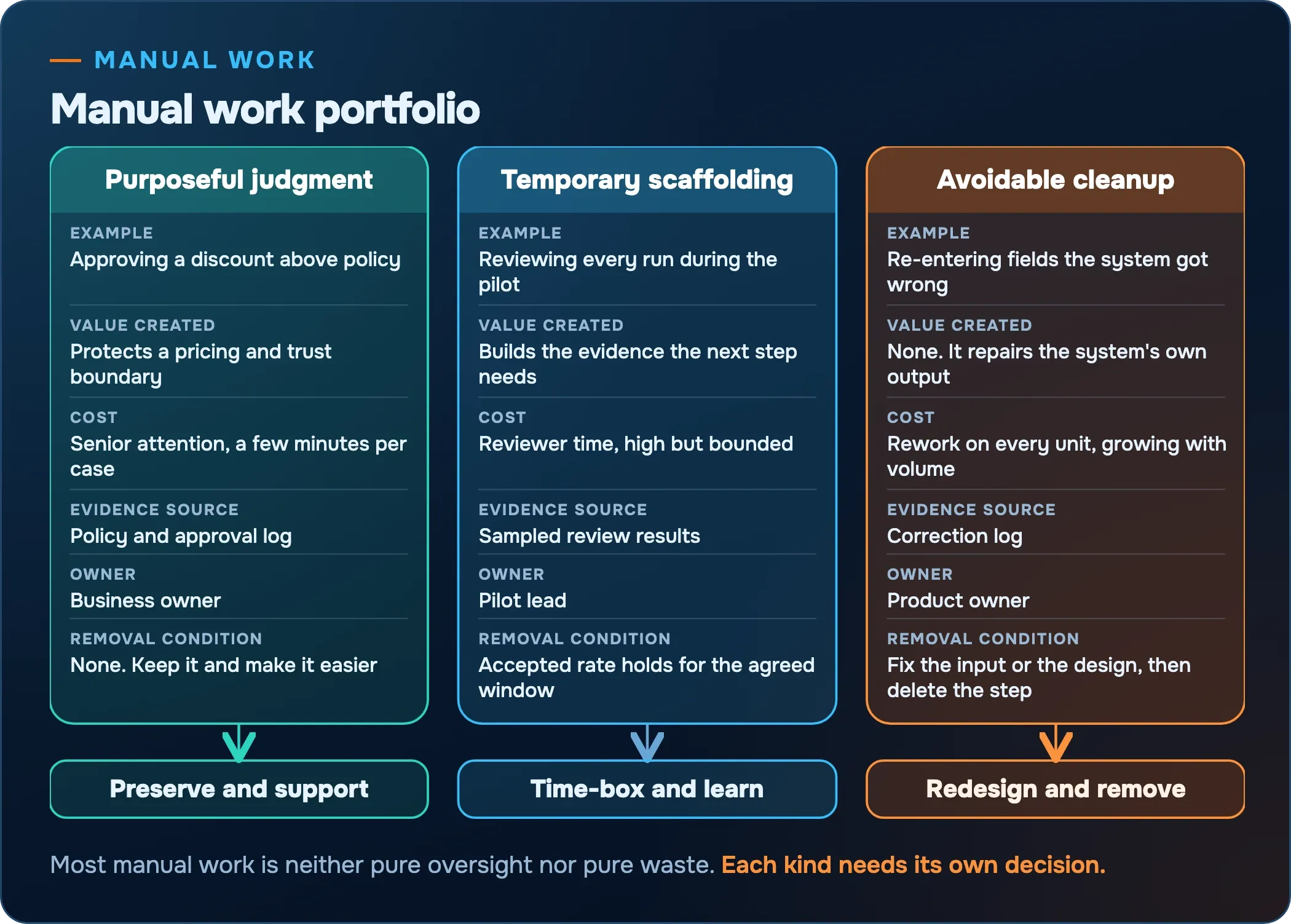
Human work inside an AI workflow has at least three different functions.
Purposeful judgment protects a legal, commercial, quality, safety, or trust boundary. The person is not correcting a weak system by accident. They are making a decision the organization deliberately wants a human to own.
Temporary scaffolding helps the team learn. People may classify cases, correct outputs, resolve exceptions, or review every run while the workflow is still collecting evidence. This can be a responsible pilot design, provided the work has an owner, a reason, and a review date.
Avoidable cleanup exists because of design debt. It includes duplicate entry, predictable formatting, repeated context search, preventable correction, and repair after an unsafe write. This work should not be normalized as “human in the loop.” It should become a product or process backlog.
The categories matter because each one leads to a different decision. Purposeful judgment may stay and become easier. Scaffolding may narrow as evidence grows. Avoidable cleanup should be designed out or priced honestly.
The NIST AI Risk Management Framework calls for defined human oversight, clear roles, ongoing monitoring, and documented performance under deployment conditions. That supports an important principle: human involvement should have an explicit function. “A person checks it” is not a control design until the team knows what the person is deciding, what evidence they receive, and what happens when they disagree.
Preparation is part of automation
Some workflows look automated because the preparation happens before the measured event. People clean files, reconcile records, label examples, request access, remove duplicates, or reconstruct missing context. Once the input reaches the model, the visible run is fast.
Those hours belong to the workflow economics. They also belong to the product decision. If every new customer requires a founder to repair the data manually, the system may work technically while the implementation model remains unscalable.
The team should record preparation by trigger and role. Is it required for every unit, every batch, every customer, or only a new integration? Does the work create a reusable asset, or does it recur without improvement? A one-time migration cost and a permanent per-unit cost should not be blended.
This is especially important in pilots. Early teams often provide unusually high-touch support to create a fair test. That is legitimate. The business case should show which work is a temporary learning investment and which work would survive paid deployment.
Review has more than a time cost
Review should be measured in minutes, but minutes are only the beginning.
Who performs the review? What expertise is required? Does the task interrupt deeper work? Does it create a queue before the customer can act? Can it be batched? Does the reviewer receive enough source context to make a responsible decision?
Five minutes of bounded operational checking is different from five minutes of founder or specialist attention. The nominal duration may be the same, while the capacity constraint and opportunity cost are very different.
Review also creates value. It can prevent a customer-facing error, protect a policy boundary, detect a segment mismatch, or produce corrections that improve the system. A business case that counts review only as cost will push toward automation even when the judgment is doing important work.
The right question is not “can we remove the human?” It is “which judgment do we need, and how can the system make it cheaper, clearer, and more reliable?”
That is why The Review Loop Is The Real AI Product treats corrections as product input rather than only error handling. Review earns its place when it protects a boundary or helps the workflow learn. It becomes waste when the same preventable correction repeats without changing the system.
Exceptions define the capacity ceiling
Average performance can make a workflow look healthier than it is. The common cases may be fast, while a small number of exceptions consume most of the expert attention.
Measure exception frequency, but also severity and recovery effort. A rare case that requires a senior operator, interrupts a customer workflow, or creates downstream cleanup can dominate the economics. If the system expands volume, the exception tail may grow faster than the team expected.
This is one reason an automation percentage is a weak business metric. “Ninety percent automated” says nothing about whether the remaining ten percent contains the hardest, most expensive, or most consequential work.
The team may choose to narrow scope, route complex cases earlier, keep a specialist review, improve the input, or price the service around the true exception load. All are better decisions than assuming the tail will disappear after launch.
Approvals need a decision design
Some approvals remain because policy or risk requires them. Others survive because the system has not earned more authority. Either way, the approval step needs a job.
What is the person deciding? What evidence is visible? Which changes are allowed? How are low-risk cases distinguished from high-risk ones? Can similar approvals be batched without hiding meaningful differences?
An approval screen that asks a person to click “accept” without showing source or consequence transfers liability without supporting judgment. The human remains in the loop, but the control is mostly ceremonial.
The Acceptance Criteria Is The New Prompt provides the foundation: acceptable work should be defined before delegation. For the business case, that means counting the effort required to make the acceptance decision, not only the effort required to generate the candidate output.
Corrections are an economics signal
Accepted without change, corrected, rejected, and silently ignored outputs should not be grouped together. Each state represents different value and different retained work.
Correction also needs a type. Is the issue caused by the model, missing data, ambiguous instructions, product design, a policy rule, or a segment-specific workflow? The classification determines whether the next investment belongs in prompting, data, interface, scope, or the offer itself.
Downstream cleanup deserves special attention. A wrong field may take seconds to generate and an hour to diagnose after it changes routing, triggers a customer message, or enters a management report. The cost model should follow the consequence, not stop at the first system event.
Governance is work too
Sampling, threshold review, incident analysis, permission review, and monthly or quarterly governance do not occur for every unit. They still consume capacity and should be distributed across workflow economics.
This does not make governance an undesirable overhead. It makes the operating model honest. A workflow that requires periodic review to remain safe and useful should include that work in its owner model and price.
The UK government’s Magenta Book guidance on value-for-money evaluation offers a broader principle: relevant direct and indirect costs should be considered, and costs or benefits that cannot be monetized should still be included qualitatively. An AI business case should apply the same discipline. If human judgment, interruption, trust, or risk reduction cannot be reduced to a neat dollar value, they should not disappear from the decision.
Build a Manual Work Ledger
For one workflow, record every human action between input and accepted outcome. Use these fields:
- unit of work;
- manual task and trigger;
- frequency;
- minutes and queue delay;
- role and required expertise;
- direct cost or capacity constraint;
- value created or failure prevented;
- evidence source;
- category: judgment, scaffolding, or cleanup;
- removal or retention condition;
- owner and next review date.
Then calculate human minutes per accepted outcome, not per generated output.
Run the ledger first against the current manual baseline, then during the pilot. Compare preparation, generation, review, correction, exception, approval, and downstream cleanup. Keep the comparison window and scope explicit. Do not publish an ROI number unless the baseline, period, included costs, and limitations are documented.
The result may lead to several legitimate decisions: automate the next step, improve the input, narrow the scope, preserve human judgment, redesign the offer, change pricing, extend the pilot, or stop. No single automation rate should decide among them.
Proof Engine’s AI Workflow / Internal Product Build work treats workflow economics, review, controls, and operating fit as part of the build decision. The goal is not more automation. It is a system that creates accepted work with evidence the organization can trust and economics it can sustain.
Pick one AI workflow. Calculate the total human minutes per accepted outcome. Then name one manual activity the system should preserve and support, and one it should stop creating.
FAQ
What is the accepted outcome, and why measure it?
The approved CRM update, accepted draft, completed handoff, resolved case or decision-ready brief. A generated output is only an intermediate event, and the work between the output and the accepted outcome is part of the system, so the economics should be counted per accepted outcome rather than per generated output.
Is all manual work in an AI workflow waste?
No. Purposeful judgment protects a legal, commercial, quality, safety or trust boundary. Temporary scaffolding helps the team learn during a pilot and needs an owner, a reason and a review date. Avoidable cleanup comes from design debt and should be designed out or priced honestly.
Why is an automation percentage a weak business metric?
“Ninety percent automated” says nothing about whether the remaining ten percent holds the hardest, most expensive or most consequential work. Exception frequency, severity and recovery effort often set the capacity ceiling.
What is a Manual Work Ledger?
A record of every human action between input and accepted outcome for one workflow: unit of work, task and trigger, frequency, minutes and queue delay, role and expertise, direct cost or capacity constraint, value created, evidence source, category, removal or retention condition, and owner. The result is human minutes per accepted outcome.
Sources
- NIST AI Risk Management Framework: AI RMF Core for defined human oversight, clear roles, ongoing monitoring and documented performance under deployment conditions.
- UK government: Magenta Book Annex A analytical methods for use within an evaluation for including relevant direct and indirect costs, and for including costs and benefits that cannot be monetized qualitatively.
- Proof Engine blog: The Acceptance Criteria Is The New Prompt
- Proof Engine blog: The Review Loop Is The Real AI Product
- Proof Engine blog, same series: The Buyer Needs A Way Back, AI Summaries Need A Disagreement Layer
- Proof Engine: AI Workflow / Internal Product Build