

The Buyer Needs A Way Back
One of the best buying questions sounds like doubt:
“What happens if we need to go back?”
A seller can hear resistance and respond by repeating the upside. The product is faster. The workflow is simpler. The pilot is limited. The team will support the implementation. Those answers may all be true, but they miss the decision the buyer is trying to make.
The buyer is imagining the system inside the company. They are asking what work will stop, which records will change, who will depend on the new path, and what the organization will have to do if the system is wrong, unavailable, or simply not a fit.
That question is often a sign that the evaluation has become concrete.
Reversibility is not one feature
Teams use “rollback” as though it describes a single capability. In practice, a way back has several different functions:
- stop future actions;
- undo a completed change;
- recover or export data;
- restore service;
- continue critical work manually;
- compensate for an irreversible consequence.
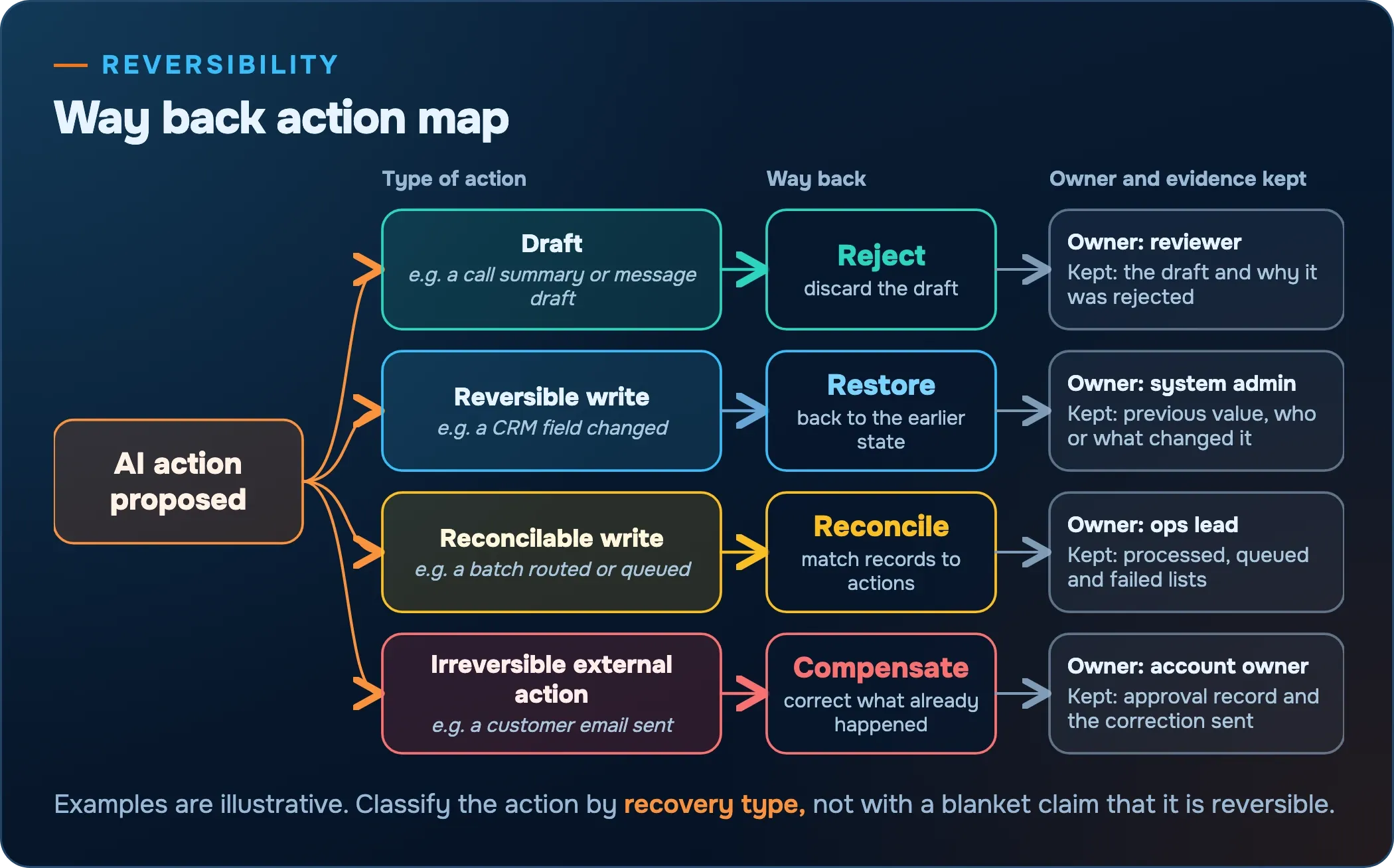
A workflow may support some of these and not others. A draft can be deleted. A CRM field can often be restored if its history was preserved. An email already sent to a customer cannot be unsent in any meaningful operational sense. A pricing approval or customer promise may require a correction, not a rollback.
The buyer needs the boundary, not the assurance that everything is reversible.
This matters more as AI systems move from observation toward action. A system that summarizes a call has a different failure surface from one that updates a CRM, routes a case, sends a message, or approves a price. Authority increases the value of stop controls, review, audit history, and recovery evidence.
The NIST AI Risk Management Framework connects safe operation with monitoring, human intervention, and the ability to shut down or modify systems that deviate from expected behavior. It also describes resilience as the ability to withstand unexpected events or degrade safely. For a buyer, those are not abstract governance characteristics. They are operating questions.
Start with the stop control
The first question is simple: who can pause the workflow, and how quickly?
A button is not a control if no one knows who may use it, what happens to queued work, whether in-progress actions complete, or how users learn that the system has stopped. The control needs an owner, a confirmation path, and a defined system state after activation.
For low-risk work, a delayed stop may be acceptable. For a workflow that can contact customers or alter an operating record, the response window may need to be much shorter. The standard should follow the consequence, not the sophistication of the technology.
The next question is whether the action can be undone. If the system changes a CRM field, is the previous value preserved? Can a reviewer see who or what made the change? Can the record be restored without losing subsequent legitimate edits? “We have logs” is not the same as “we can recover the state safely.”
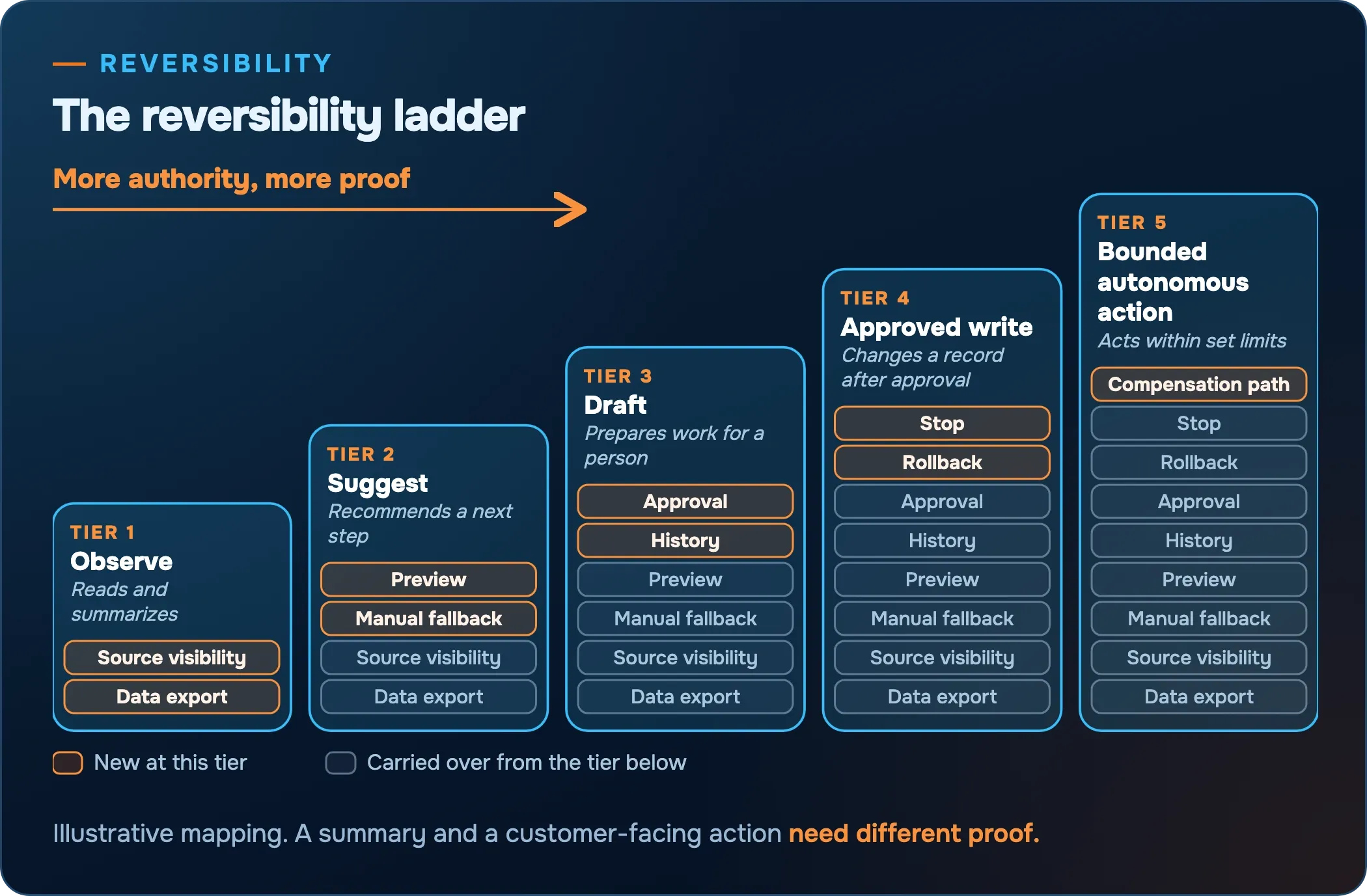
This is why AI should earn write access gradually. Observation, suggestion, drafting, approved writes, and bounded autonomous actions are different permission tiers. Each tier should carry a stronger control and recovery requirement than the one before it.
Data has its own way back
Buyers also need to understand the data path. What can be exported? In what format? Does the export preserve source and timestamps? What remains after termination? Which records exist only inside the provider’s system, and which can be reconstructed elsewhere?
Portability is not a complete exit plan, but it changes the risk. A customer may accept a new workflow more readily when they know the evidence, decisions, and operational history will not disappear if the relationship ends.
The same principle applies during an incident. If an integration fails, can the team see which records were processed, which were queued, and which require reconciliation? Recovery without provenance can create a second problem: the system returns, but no one knows what it already did.
That is why The Data Layer Is Becoming A Trust Layer matters here. Trust depends not only on storing information, but on preserving source, recency, authorship, and the relationship between a record and the action taken from it.
Manual fallback must be real
Sellers often say the team can “always do it manually.” That statement needs the same scrutiny as the automated path.
Can users access the required data without the AI system? Do they know the manual sequence? Is the fallback available to the right roles? How much work can it handle, and for how long? Does returning to manual operation create a backlog that the team cannot clear?
A fallback that exists only in theory will fail an operating review. The buyer is not asking whether manual work is conceptually possible. They are asking whether critical work can continue inside the actual staffing, data, and timing constraints of the organization.
Recovery time is therefore part of reversibility. A system may be technically recoverable and operationally unacceptable if restoration takes three days while the workflow produces customer commitments every hour. The plan needs an owner and an expected path, not a vague promise that support will help.
Some consequences can only be compensated
An honest seller should identify the residue that cannot be removed.
Once a customer message is sent, the company may need to send a correction. Once a person acts on a wrong recommendation, the record may be restored but the decision still happened. Once sensitive data leaves an approved boundary, deleting a local copy does not erase the exposure.
These cases do not make the workflow unsellable. They change the design. Irreversible actions need tighter permission, preview, approval, narrower scope, and a clear compensation path. The company may choose to keep them outside the pilot until it has stronger evidence.
This is where The Acceptance Criteria Is The New Prompt becomes a control principle. Before a system takes consequential action, the team should define what acceptable completion means, which evidence is required, and which conditions force review or stop.
Reversibility makes a pilot more credible
A pilot should not merely reduce the number of users or the length of the contract. It should bound the consequence of being wrong.
Limit the action class, data set, users, records, or time window so that failure can be detected and localized. Start in observation or suggestion mode when write access is not yet justified. Use a small enough scope that the team can reconcile every affected record if needed.
This does not mean designing a pilot so cautiously that it cannot test the real workflow. It means aligning the test with the current evidence. The pilot can expand authority as the team proves accuracy, review behavior, ownership, and recovery.
A Pilot Needs A Conversion Contract explains why the parties should agree in advance what evidence leads to stop, extension, paid deployment, or expansion. Reversibility belongs in that contract because the decision is not only whether the workflow creates value. It is whether the organization can adopt it inside an acceptable risk boundary.
Write a Way Back Receipt
For one consequential workflow, document:
- the action and downstream consequence;
- who can stop future actions;
- what happens to queued and in-progress work;
- what can be rolled back;
- what requires reconciliation;
- what cannot be undone;
- how data is exported or recovered;
- the manual fallback;
- the recovery owner and expected time;
- the compensation path for irreversible residue;
- the date the path was last tested.
The artifact should be short enough to use in a demo, offer, security review, or pilot brief. The purpose is not to produce another policy document. It is to make the operating promise inspectable.
Show the way back in the demo
Most demos show the happy path. The system receives the right input, produces the right output, and completes the workflow. A buyer evaluating operational risk needs a second path.
Show the pause. Show the exception. Show how a user rejects or corrects an output. Show the history. Show what the team does when data is missing or an integration is unavailable. If the action cannot be undone, show the approval and compensation boundary.
This can be more persuasive than another feature. It turns “we take control seriously” into observable proof.
The same evidence should appear in the offer. Scope and pricing may need to include migration, review, data handling, recovery responsibilities, and retained human work. Reversibility is not a hidden engineering detail when it determines whether the buyer can accept the implementation.
Proof Engine’s AI Workflow / Internal Product Build work starts from the operational decision and the evidence needed to make it. For a buyer considering an AI-enabled workflow, one of those decisions is often: can we move forward without creating a dependency we cannot safely unwind?
A way back helps the buyer move forward
A mature seller does not promise that every consequence disappears. They explain the exact control boundary, test the most important recovery path, and identify the actions that require more evidence before authority expands.
That honesty reduces perceived risk because it replaces reassurance with a plan. It also improves the product: every hard-to-answer rollback question reveals missing ownership, history, export, fallback, or permission design.
Choose one AI action with a real downstream effect. Write its Way Back Receipt before the next buyer conversation. Then show the buyer not only what the workflow can do, but how the organization remains in control if the answer changes.
FAQ
Why do buyers ask what happens if they need to go back?
Because the evaluation has become concrete. The buyer is imagining the system inside the company: which work will stop, which records will change, who will depend on the new path, and what the organization has to do if the system is wrong, unavailable or not a fit.
What does reversibility include beyond a rollback button?
Six different functions: stopping future actions, undoing a completed change, recovering or exporting data, restoring service, continuing critical work manually and compensating for an irreversible consequence. A workflow may support some of them and not others.
What is a Way Back Receipt?
A short artifact for one consequential workflow that records the action and its downstream consequence, who can stop future actions, what happens to queued work, what can be rolled back, what requires reconciliation, what cannot be undone, how data is exported or recovered, the manual fallback, the recovery owner and expected time, the compensation path and the date the path was last tested.
How does reversibility make a pilot more credible?
A pilot should bound the consequence of being wrong, not only reduce the number of users. Limit the action class, data set, users, records or time window; start in observation or suggestion mode when write access is not yet justified; and expand authority as accuracy, review behavior, ownership and recovery are proven.
Sources
- NIST AI Risk Management Framework: AI Risks and Trustworthiness for monitoring, the ability to shut down, modify or intervene, and resilience that degrades safely.
- Proof Engine blog: The Data Layer Is Becoming A Trust Layer
- Proof Engine blog: The Acceptance Criteria Is The New Prompt
- Proof Engine blog: A Pilot Needs A Conversion Contract
- Proof Engine blog, same series: The Old Workflow Needs An Exit Date, What Stays Manual Belongs In The Business Case
- Proof Engine: AI Workflow / Internal Product Build