

AI Summaries Need A Disagreement Layer
The most dangerous AI summary may be perfectly readable.
It says the customer is interested. Security was discussed. The workflow appears relevant. The team will review internally and return with next steps. Nothing in the paragraph is obviously false, yet the paragraph can still describe a deal that does not exist.
The champion may want speed. The end user may fear a new review burden. Security may not accept the data path. Finance may not see the comparison baseline. The implementation owner may not have joined a single call. Compress those positions into one account-level summary and the system creates consensus that the buying group never reached.
Summarization and customer intelligence are not the same job.
Compression removes detail. Decisions depend on some of it.
The purpose of a summary is to reduce the amount of material a person has to read. That is useful. A sales manager should not need to replay every conversation to understand an opportunity, and a seller should not need to search a transcript for every commitment.
But B2B decisions are made by groups whose members carry different risks. A concise account view is only useful if it preserves the differences that change the next action. When compression removes who said what, under which condition, and with what authority, it removes the structure of the decision.
Research on meeting summarization points to the underlying difficulty. A 2024 paper in the ACL Anthology, What’s under the hood: Investigating Automatic Metrics on Meeting Summarization, names speaker dynamics and contextual turn-taking as key challenges of meeting summarization, and missing information and linguistic inaccuracy as error types, and argues that common automatic metrics are not tailored to capture these meeting-specific errors. A fluent paragraph can therefore be a weak proxy for whether the summary preserved what mattered.
In revenue work, one of the things that matters most is disagreement.
A buying group is not one buyer
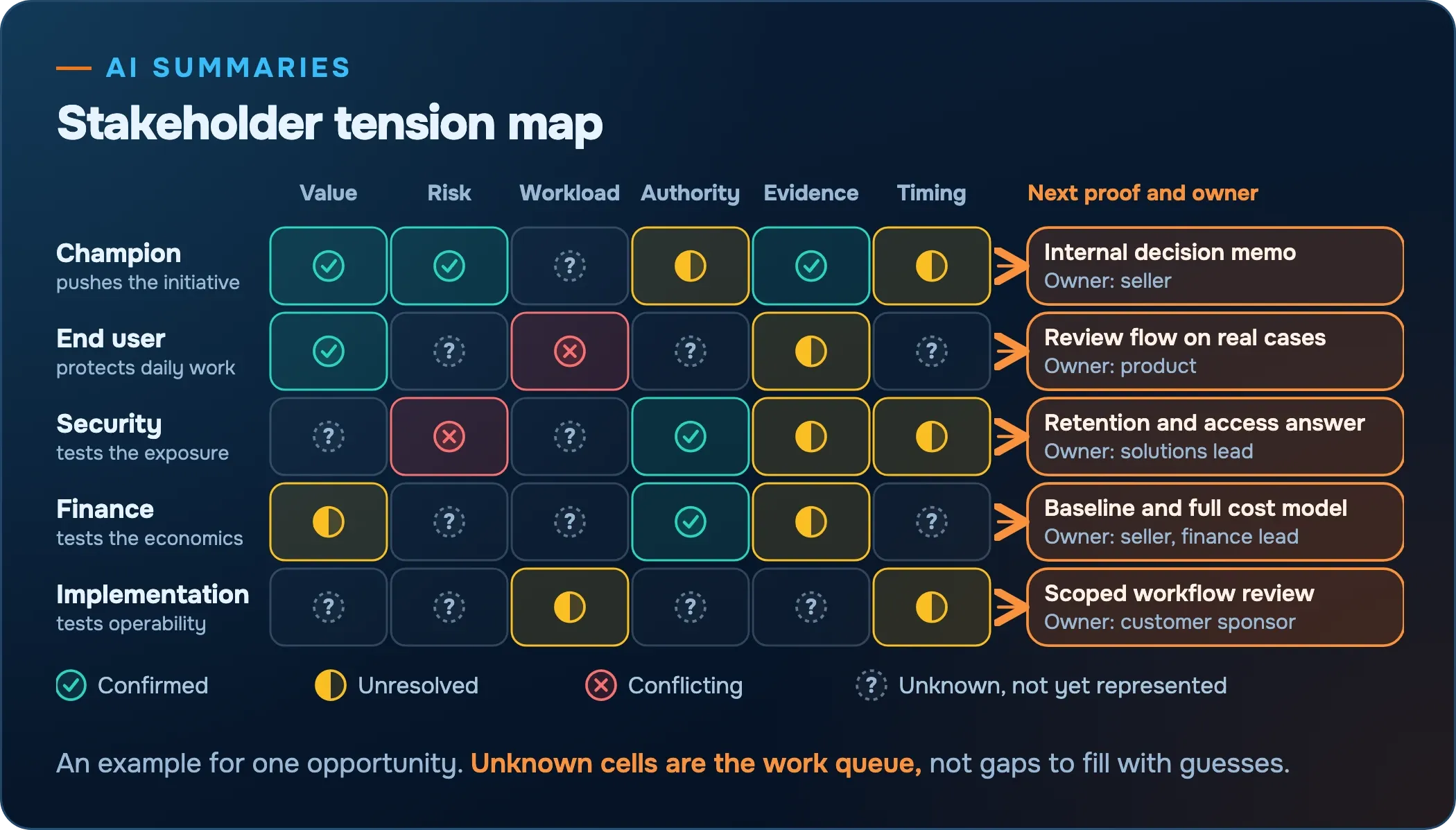
The label “customer” hides several jobs. A champion tries to move the initiative. An end user protects the daily workflow. A manager cares about control and performance. Security tests exposure. Finance tests the economics. Implementation tests whether the change can operate inside the existing system.
They may all agree that a problem exists while disagreeing about whether this solution should be adopted. They may agree with the outcome and disagree with the migration burden. They may agree to a pilot and disagree about what would justify paid expansion.
Account-level sentiment cannot express these states. “Positive” may mean one person is enthusiastic, two people are cautious, and one critical role has not been represented. The system should not treat that as a soft version of consensus. It should treat it as a structured set of unresolved conditions.
This is why the useful object is not only a summary. It is a map of positions, evidence, and missing voices.
Preserve four layers
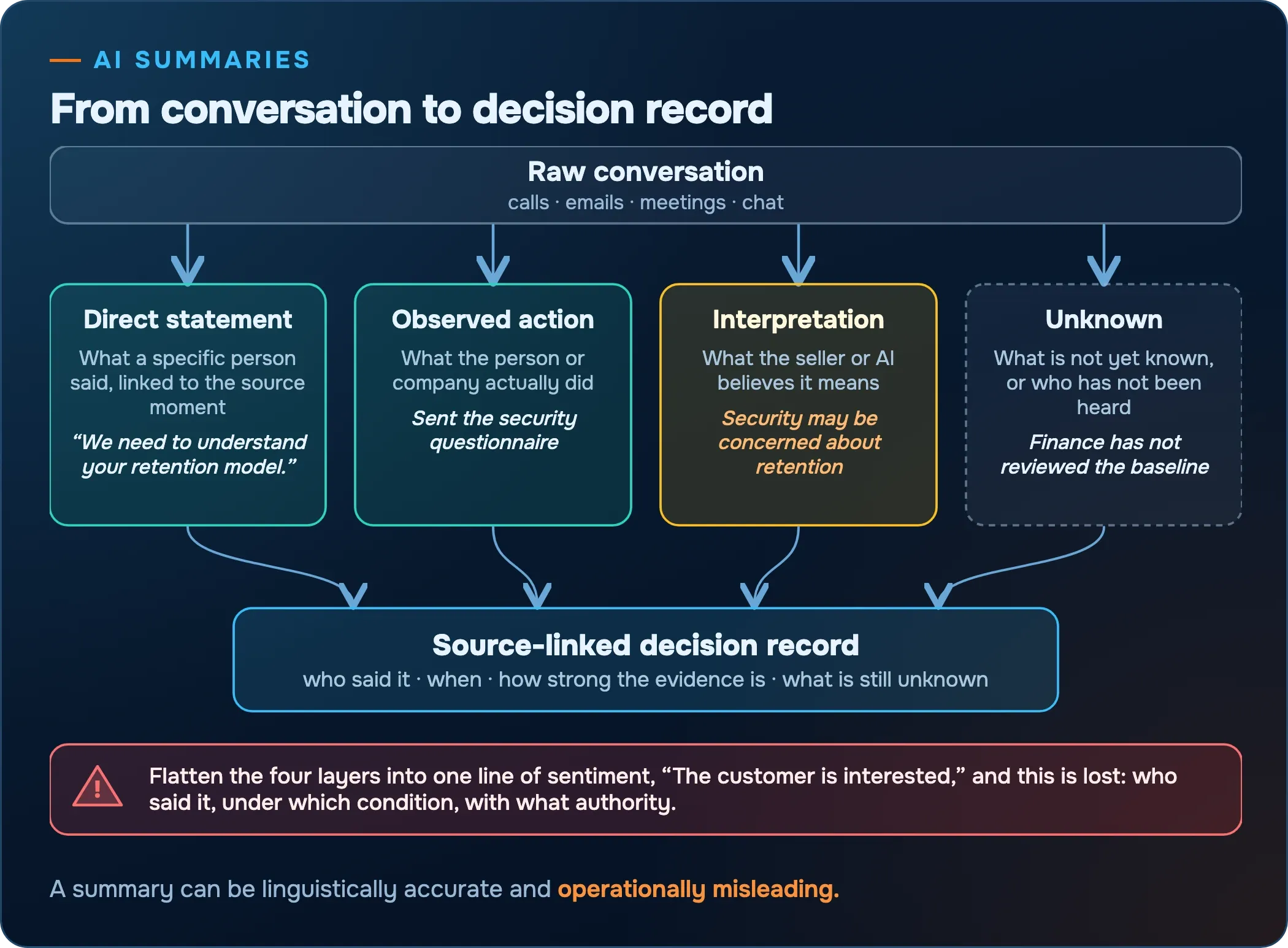
At minimum, the record should separate four kinds of information:
- Direct statement: what a specific person said, linked to the source moment.
- Observed action: what that person or organization actually did.
- Interpretation: what the seller or AI believes the statement or action means.
- Unknown: what the team does not yet know or who has not yet been represented.
These layers are easy to collapse. A stakeholder says, “We need to understand your retention model.” The summary becomes “Security is concerned about retention.” That may be correct, but it is already an interpretation. The person may be gathering information rather than objecting. The concern may belong to legal rather than security. The requirement may apply only to one data class.
The difference matters because the next step changes. A direct question needs an answer. A formal objection needs evidence and perhaps a decision owner. An unknown needs discovery, not reassurance.
The NIST AI Risk Management Framework reinforces this evidence discipline. It calls for documented roles, human oversight, ongoing monitoring, and interpretation of AI output within its context. In a customer-intelligence workflow, context includes the speaker, source, recency, decision role, and the boundary between evidence and inference.
Different stakeholders create different tensions
A champion can believe in the value and still lack the authority, time, or artifact required to move the decision internally. Positive language from the champion is useful, but it does not prove that the organization can coordinate the next step. The system should record what the champion can do, what they have done, and which internal dependency remains.
An end user can recognize the problem and resist the solution because the proposed workflow adds review, data entry, or exception handling. That is not hypocrisy. It is a different cost model. If the summary stores only problem recognition, the seller may continue proving value while ignoring adoption risk.
Security and data concerns need an object. “Security concern” is too broad to guide action. Is the issue recording, consent, retention, access, model processing, export, residency, authentication, or integration? Each concern belongs to a different owner and requires different evidence.
Finance may not reject the value. Finance may reject the comparison. If the business case counts model output but ignores retained manual review, the missing proof is not another demo. It is a credible baseline and a full cost model.
Implementation can accept the desired outcome and reject the path to it. A product can be valuable but incompatible with the available data, ownership model, migration window, or system dependencies. Desirability and implementability should therefore remain separate fields.
Finally, the missing stakeholder is a real signal. If a decision depends on a role that has not participated, the system should not infer that role’s position from the champion’s confidence. “Unknown - not yet represented” is more useful than a complete-looking summary built on borrowed certainty.
Classify only what changes the next step
A disagreement taxonomy can help, but it can also become decorative. The point is not to label every tension. The point is to route the right proof, question, or owner.
Useful categories include conflicting goals, different evidence standards, timing, authority, risk tolerance, and workload. A conflict over evidence standard may require a pilot result or security artifact. A conflict over authority may require a stakeholder introduction. A conflict over workload may require a narrower workflow or a clearer manual-work model.
The category earns its place when it changes the next move.
For every position, preserve the source and time. A statement from three months ago should not silently describe the account after a new stakeholder joins or the product scope changes. Recency is part of truth. So is confidence: direct statement, observed behavior, seller inference, and AI inference should not carry the same weight.
This is the same reason the data layer is becoming a trust layer. A record becomes useful for action when the user can see where it came from, how current it is, and what kind of claim it represents.
Build a Stakeholder Tension Map
The practical artifact can be small. For one active opportunity, create a table with these fields:
- stakeholder and decision role;
- stated priority;
- stated concern;
- observed action or commitment;
- source and date;
- seller or AI inference;
- unresolved decision;
- next proof or question;
- owner;
- confidence;
- review date.
Do not fill empty cells with guesses. Missing information is the work queue.
The map should not replace the account summary. It should constrain it. A strong summary can still be concise: “The champion has confirmed the workflow and introduced operations. Security has requested retention and access details. Finance has not yet reviewed the baseline. Implementation ownership remains unassigned.” That paragraph is short, but it preserves the unresolved structure.
Follow-up changes when disagreement is visible
Without a disagreement layer, follow-up tends to become a polished recap: thank you, here is what we discussed, here are the next steps. With the layer, follow-up can do decision work.
The champion receives an internal memo. Security receives the exact data-flow answer. Finance receives a baseline and cost logic. Implementation is invited to a scoped workflow review. The seller asks for the missing role rather than sending the same deck to everyone.
This is where The Buyer Artifact Behind The Deal becomes practical. A buyer artifact is not generic collateral. It carries the proof required by a particular stakeholder into the internal decision the seller cannot attend.
Manager review changes as well. Instead of asking whether the deal “feels good,” a manager can ask which condition remains unproven, whether the right owner is involved, and what event would change the account state. Coaching, product proof, commercial redesign, and disqualification become easier to distinguish.
AI should surface tension, not invent it
An AI-enabled flow might move from transcript to source-linked stakeholder claims, then identify possible contradictions, ask for human confirmation, update approved CRM objects, and recommend the next proof. That is a useful direction for conversation intelligence, including systems shaped like Sales Blackbox.
But the system should not manufacture certainty. It should not assign a silent stakeholder a belief, convert one vague sentence into a formal objection, or present contradiction detection as a final judgment. The role of AI is to make evidence reviewable and disagreement visible. The consequential interpretation remains bounded by the available sources and the human owner.
This design also supports better CRM memory. In CRM Is Becoming The Memory Layer For Revenue Work, we argued that customer state should survive calls and handoffs. A disagreement layer adds an important condition: the memory should preserve multiple positions without forcing them into one account opinion.
Map one disagreement before writing the next summary
Choose one active opportunity with more than one stakeholder. Do not start with overall sentiment. Write the latest confirmed condition for each person involved. Mark direct statement, observed action, inference, and unknown separately. Then identify the one disagreement that most changes the next decision.
If the seller cannot name that disagreement, another meeting may add conversation without adding movement. If the AI cannot preserve it, a cleaner summary may make the deal harder to understand.
The best customer intelligence does not make the organization sound aligned. It shows the work required for alignment to become real.
FAQ
Why can an AI account summary be dangerous even when nothing in it is false?
A readable paragraph can still describe a deal that does not exist. Compressing a champion who wants speed, an end user who fears review work, a security team that does not accept the data path and an implementation owner who has not joined a call into one account-level summary creates a consensus the buying group never reached.
What should a disagreement layer preserve?
Four kinds of information, kept separate: the direct statement, linked to the source moment; the observed action; the interpretation, meaning what the seller or AI believes it means; and the unknown, meaning what is not yet known or who has not been represented. Each position also keeps its source, date and confidence.
What is a Stakeholder Tension Map?
A small table for one active opportunity: stakeholder and decision role, stated priority and concern, observed action, source and date, seller or AI inference, unresolved decision, next proof or question, owner, confidence and review date. It constrains the account summary rather than replacing it, and empty cells are not filled with guesses.
Should AI detect stakeholder disagreement automatically?
It can surface tension: move from transcript to source-linked claims, flag possible contradictions and ask for human confirmation. It should not give a silent stakeholder a belief, turn one vague sentence into a formal objection or present contradiction detection as a final judgment.
Sources
- ACL Anthology: What’s under the hood: Investigating Automatic Metrics on Meeting Summarization for meeting-specific summarization challenges and error types.
- NIST AI Risk Management Framework: AI RMF Core for documented roles, human oversight, ongoing monitoring and interpreting AI output within its context.
- Proof Engine blog: CRM Is Becoming The Memory Layer For Revenue Work
- Proof Engine blog: The Data Layer Is Becoming A Trust Layer
- Proof Engine blog: The Buyer Artifact Behind The Deal
- Proof Engine blog, same series: The Buyer Needs A Way Back, What Stays Manual Belongs In The Business Case
- Sales Blackbox: sales call recording, QA and CRM