

The First Customer Is A Company-Wide Test
The first customer rarely tests only the thing you built.
They test whether the promise made in the sales conversation survives onboarding. They test whether the required data can actually be accessed, whether someone owns the implementation, whether exceptions can be handled, whether support knows what to do, whether billing matches the offer, and whether the team can explain what changed after real use. A product may perform exactly as designed and the customer experience can still fail around it.
This is why the first customer is not just a product milestone. It is the first end-to-end test of the company.
That distinction matters because early teams naturally concentrate on the center of the picture: the feature, model, workflow, or service that creates the visible result. The surrounding work looks secondary until a real customer arrives. Then the edges become the experience. A missing data permission, an unclear owner, a slow handoff, or a support question with no route can carry more commercial weight than the quality of the core output.
The product is only one lane
When teams describe a customer journey, they often describe what the user sees. The customer receives an invitation, connects a system, runs a workflow, reviews an output, and decides whether it helped. Behind each visible step, however, someone inside the company has to prepare, coordinate, approve, monitor, and respond.
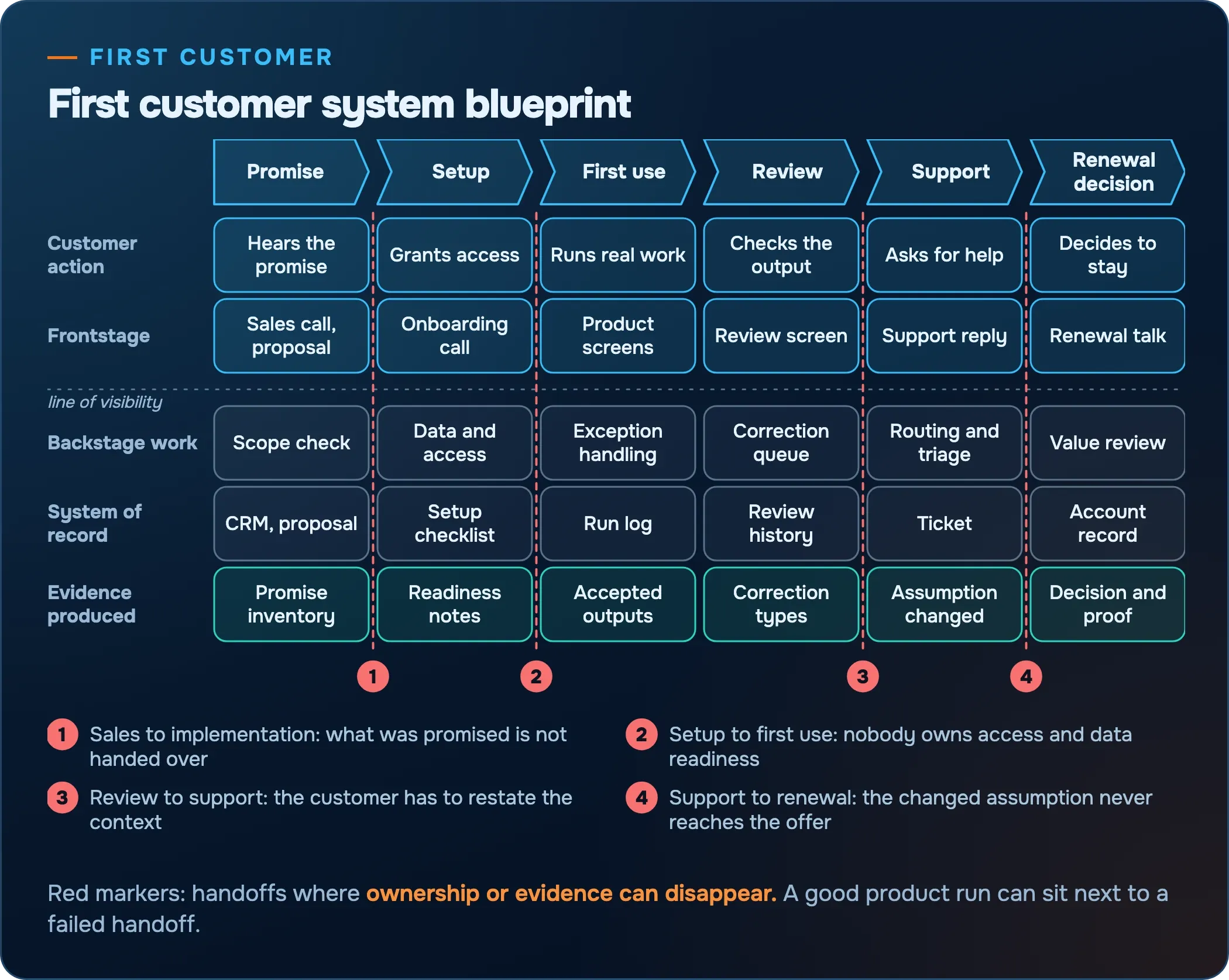
Service design has a useful language for this. Nielsen Norman Group describes a service blueprint as a map of customer actions, frontstage interactions, backstage actions, and support processes. The point is not the diagram itself. The point is that an experience that looks simple to the customer may depend on several invisible systems working together.
Your first customer exposes those dependencies before they have become routine. Sales may understand the promise but implementation may not know which part is contractual. Product may know the expected input but the customer may not have access to it. The founder may know how to fix an exception, while no one else knows that the exception exists.
Start with the promise
The first test begins before onboarding. It begins with what the customer believes they bought.
If sales promised “automated follow-up,” the operating meaning has to be explicit. Does the system draft a follow-up, recommend one, send it after approval, or send it autonomously within defined boundaries? Who confirms the recipient, the timing, and the content? What happens when the source data is incomplete? A broad promise can create a successful demo and an impossible implementation at the same time.
This is why the GTM motion is part of the product surface. A landing page, call, proposal, pilot brief, and onboarding checklist all shape the workflow the buyer expects. In The GTM Motion Is A Product Surface, we argued that these artifacts do more than explain the product: they create buyer behavior and produce evidence. The first customer reveals whether those surfaces describe the same reality.
A useful first-customer review should therefore start with a promise inventory. What outcome was stated? What workflow was described? What was explicitly in scope? What did the customer infer even though the team never said it directly? The goal is not to police language. It is to find the point where expectation and operating design diverged.
Access is part of product readiness
Many early implementations stall before the product has a fair chance to perform. The required data is scattered, the integration owner is unavailable, recording consent has not been resolved, the sample does not represent production conditions, or the customer cannot expose the workflow the way the pilot assumed.
These are not automatically product failures. They are readiness signals. They tell you what the product requires from the environment in which it is expected to work.
The mistake is to leave those requirements as private implementation knowledge. If a workflow needs clean records, a named administrator, a minimum call volume, weekly review, or access to a particular system, those conditions belong in qualification, scope, onboarding, and the commercial decision. Otherwise the company continues selling an outcome while discovering the prerequisites only after signature.
The first customer gives the team its first real opportunity to replace imagined readiness with observed readiness. Which permissions took days instead of hours? Which input had to be reconstructed manually? Which stakeholder was missing? Which assumption about the customer’s process turned out to be wrong? Each answer should change something upstream.
Ownership becomes visible when something stops
Early workflows often appear owned while everything is moving. The founder is on every call, the product lead watches every run, and the customer has one enthusiastic champion. Ownership becomes clearer when an output is rejected, a data source fails, a user misses a review, or a promised next step does not happen.
At that moment, the company needs more than goodwill. It needs a named person who can decide. Who determines whether the issue is a product defect, an onboarding gap, a customer-side dependency, or an out-of-scope request? Who speaks to the customer? Who updates the evidence record? Who can stop the workflow if the risk is higher than expected?
This is one reason acceptance criteria matter. As The Acceptance Criteria Is The New Prompt explains, delegation becomes reliable when the team defines what acceptable work looks like before the system acts. The same logic applies to the company around the product. An implementation needs criteria for acceptable inputs, accepted outputs, escalation, support response, and commercial continuation.
Handoffs are where the company disappears
A first customer may speak to sales, product, implementation, support, and finance in the same week. The customer experiences one company. Internally, each team sees a different object: an opportunity, a ticket, a workflow, an invoice, or a renewal risk.
If context does not travel with the customer, each handoff forces them to restate the problem. Commitments lose their owner. Exceptions lose their history. A support question is resolved locally but never changes the onboarding guide. A product correction is made, but sales continues using the old promise.
The minimum useful handoff is not “customer passed to implementation.” It is a receipt: what was promised, what evidence has been collected, what remains unknown, what the customer must provide, what the company must provide, who owns the next decision, and when that decision will be reviewed.
This record also protects the team from founder memory becoming the unofficial system of record. The founder may know why the customer accepted a workaround or which stakeholder raised a concern. If that knowledge is not externalized, the company has not yet built a repeatable customer system. It has built a customer relationship that depends on one person’s recall.
Support is not downstream
The first support interaction is often treated as a small operational interruption. In reality, it is one of the first places where the company’s assumptions meet unscripted use.
A question about setup may reveal weak onboarding. A complaint about an output may reveal an unclear acceptance standard. A request for a feature may reveal a segment difference, an offer boundary, or a missing workflow step. A ticket that crosses three teams may reveal an ownership problem rather than a product problem.
The customer does not care which internal category is correct. They care whether their work can continue. The company, however, needs the classification because different signals require different changes. The first customer is teaching the company which issues belong in product, data, onboarding, support, positioning, pricing, or qualification.
Nielsen Norman Group notes that existing support tickets and interview transcripts can provide inputs to a service blueprint. That is a useful operating principle: support should not only close work. It should update the map of how the service actually functions.
Billing tests the offer
The first invoice may look far removed from product validation. It is not. Billing tests whether the company can translate its promise into a commercial unit both sides understand.
Does pricing correspond to users, volume, workflows, outcomes, implementation effort, or a fixed period? What happens when manual work increases? Which exceptions are included? What is required before expansion? A product can create value and still produce a weak business if the company cannot define or defend the unit being sold.
This is where the first customer tests more than willingness to pay. They test whether the offer has operational boundaries. The Offer Is A Test Instrument explains why buyer behavior after seeing an offer reveals readiness, risk, urgency, and budget logic. The first delivery cycle reveals whether the company can fulfill that offer without hiding the real cost inside founder effort.
Evidence has to survive enthusiasm
Early teams are close to the customer, which is an advantage. They can observe nuance, adapt quickly, and make decisions without layers of coordination. That closeness also creates a risk: a few vivid moments can become a story stronger than the evidence.
The customer liked the demo. A user completed the workflow. A manager said the result was useful. These are signals, but they support different conclusions. A completed workflow may prove usability under a specific condition. It does not automatically prove retention, commercial value, or repeatable implementation.
The company needs to preserve source, date, environment, reviewer, limitation, and decision impact. That discipline is why case studies need evidence levels. The first customer should create a more accurate model of the business, not merely a stronger marketing sentence.
Founder rescue is a diagnostic
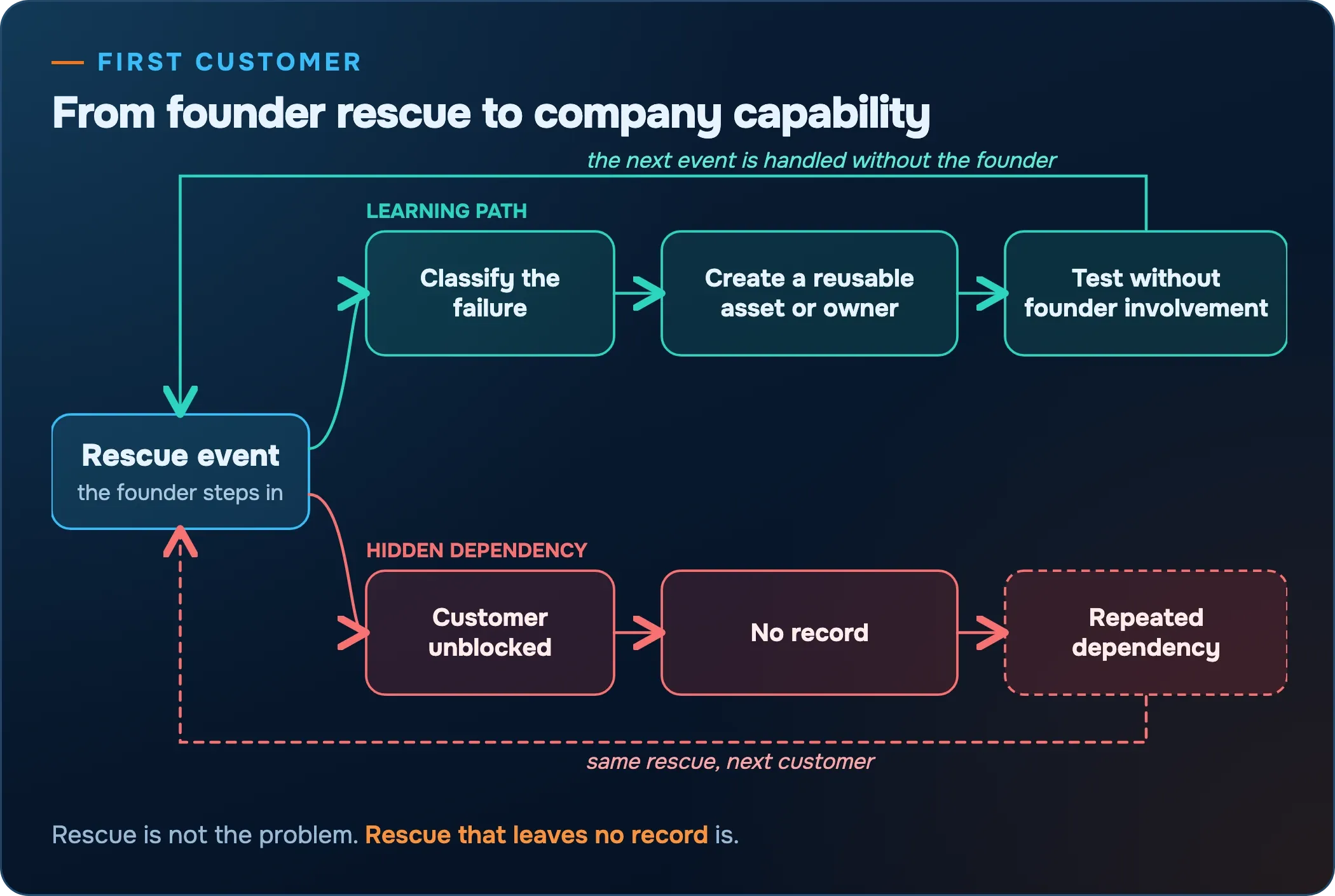
Founders will rescue early customers. That is normal. They will answer late messages, fix malformed data, rewrite an onboarding step, join a call that was not planned, or manually produce an artifact the product cannot yet create.
The question is not whether rescue happened. The question is what remains after it happened.
If the founder’s intervention creates a rule, checklist, product change, support route, evidence record, or explicit service boundary, the company has learned. If the founder quietly makes the problem disappear and the next customer requires the same intervention, the rescue has become a hidden dependency.
Build a First Customer System Test
After the first meaningful delivery cycle, review the customer across the full company rather than holding separate functional retrospectives. Use one page and ask:
- Promise: What did the customer believe would change?
- Qualification: Which readiness condition did we verify too late?
- Access: Which data, permission, or stakeholder constrained the work?
- Ownership: Who made each consequential decision?
- Handoffs: Where did context or commitment disappear?
- Controls: What could be stopped, reviewed, corrected, or escalated?
- Support: Which assumption changed after real use?
- Economics: Which manual work or exception was not in the offer?
- Evidence: What decision does the observed result support, and what does it not support?
- Repeatability: What would fail if the founder were not present next time?
The purpose is not to make the first customer look tidy. Early work will contain workarounds, manual steps, and unresolved questions. The purpose is to make the learning travel. Each issue should update an owner, artifact, workflow, boundary, or next test.
Proof Engine’s methodology begins with the decision the team needs to make and the evidence required to make it. Applied here, the decision is not only “did the customer like the product?” It is “which parts of the company are now ready to repeat this outcome, and which parts are still being carried by proximity, memory, or rescue?”
Your first customer is not a miniature version of scale. They are a high-resolution test of what scale would amplify.
Review the whole system while the evidence is still close enough to change it.
Related reading: Before the first paying customer, many teams run a design partner program; see how to find first design partners for B2B SaaS.
FAQ
Why is the first customer a company-wide test and not only a product milestone?
The customer experiences the promise from the sales conversation, onboarding, data access, ownership, support, billing and evidence handling as one company. A product can perform exactly as designed while the experience fails around it, so the first customer is the first end-to-end test of the company.
What should a first-customer review cover?
One page across the whole company instead of separate functional retrospectives: promise, qualification, access, ownership, handoffs, controls, support, economics, evidence and repeatability. It ends with the question of what would fail if the founder were not present next time.
Is founder rescue a problem?
Not by itself, because founders will rescue early customers. The diagnostic is what remains afterward. If the intervention creates a rule, checklist, product change, support route, evidence record or explicit service boundary, the company has learned. If the next customer needs the same intervention, the rescue has become a hidden dependency.
What should a handoff between teams carry?
A receipt, not a note that the customer was passed on: what was promised, what evidence has been collected, what remains unknown, what the customer must provide, what the company must provide, who owns the next decision and when it will be reviewed.
Sources
- Nielsen Norman Group: Service Blueprinting FAQ for customer actions, frontstage and backstage actions, support processes, and support tickets as blueprint inputs.
- Proof Engine blog: The GTM Motion Is A Product Surface
- Proof Engine blog: The Acceptance Criteria Is The New Prompt
- Proof Engine blog: The Offer Is A Test Instrument
- Proof Engine blog: Case Studies Need Evidence Levels
- Proof Engine blog, same series: The First Support Ticket Is A Validation Event, The Old Workflow Needs An Exit Date
- Proof Engine: Methodology