

The First Support Ticket Is A Validation Event
The first support ticket can feel like an interruption to the real work.
The team shipped the product, started the pilot, or onboarded the first customer. Now someone cannot complete a step, does not understand an output, sees unexpected behavior, or asks for a workaround. The fastest response is to solve the immediate problem and close the ticket.
That may help the customer and still waste the evidence.
An early support interaction is one of the first unscripted tests of the assumptions behind the product, offer, onboarding, data requirements, ownership model, and target segment. The user is no longer reacting to a demo. They are trying to do real work under real constraints.
The ticket is therefore not only a service event. It is a validation event.
Start with the job that stopped
Ticket categories usually describe the system: login issue, integration problem, incorrect output, feature request, billing question. Validation begins with the user’s job.
What was the person trying to accomplish? Where did they expect the workflow to take them? What happened instead? What consequence did that create? How did they continue, if they continued at all?
The same visible issue can carry different meaning in different jobs. A delayed summary may be a minor inconvenience when used for weekly review and a serious failure when it blocks same-day follow-up. A missing field may be cosmetic in one workflow and prevent routing in another.
This is why support records should preserve expected path, observed path, and consequence. The error message alone rarely explains the decision the team needs to make.
The ticket tests a chain of assumptions
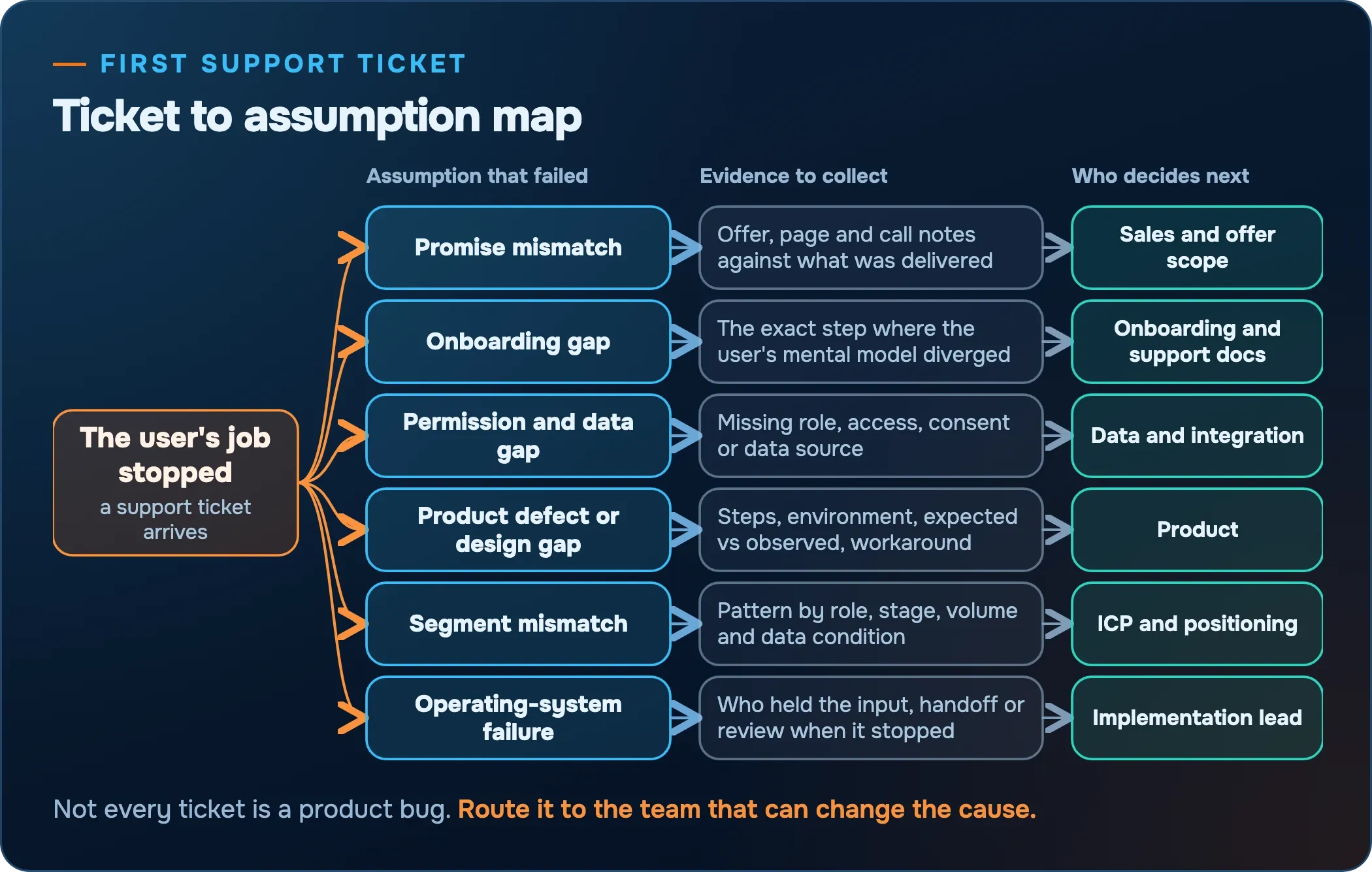
Before the customer used the product, the team made several bets. The promise described an outcome. Qualification assumed the customer was ready. Onboarding assumed instructions and access would be sufficient. Product design assumed the workflow fit. Operations assumed someone would own review and exceptions.
A support interaction can challenge any link in that chain.
The wrong response is to route every ticket to product. A product change will not repair an overbroad promise, missing permission, unclear owner, or segment mismatch. The useful question is: which assumption changed?
That question turns support from a queue into a learning surface.
Nielsen Norman Group recommends using existing qualitative inputs such as support tickets and interview transcripts when building a service blueprint. The practical value is clear: support exposes the backstage processes, handoffs, and resources that a customer journey alone may not reveal. A ticket shows where the service as delivered diverges from the service as imagined.
Promise mismatch
Sometimes the product behaves as designed and the customer is still reasonably disappointed. The sales conversation, page, proposal, or demo created a broader expectation than the delivered workflow.
The ticket may ask for automation where the offer included a draft, real-time behavior where the product runs in batches, or coverage of a case the scope excluded. The correct response is not automatically to build the request. First determine whether the promise was wrong, the scope was unclear, or the customer inferred something the team failed to correct.
This is why The GTM Motion Is A Product Surface matters after the sale. GTM artifacts shape the product the customer believes they are using. Support provides evidence about whether those surfaces produced the intended understanding.
A promise mismatch should update messaging, sales artifacts, qualification, scope, or the offer. Fixing the individual case without changing the upstream promise guarantees another version of the same ticket.
Onboarding gap
The workflow may be capable, but the customer cannot reach the useful state. Instructions assume knowledge the user does not have. Setup requires an unmentioned permission. The first output appears before the customer understands how to review it. Ownership is introduced too late.
An onboarding gap is not simply a documentation problem. It may reveal that the product requires more coordination than the offer acknowledged. The fix may be a guide, but it may also be a readiness check, configuration step, sample, approval role, or different implementation sequence.
Record the exact step where the customer’s mental model diverged from the system. “User confused” is too vague. “User expected the integration to import prior history; setup imported new records only” can change both the onboarding artifact and the commercial scope.
Permission and data gap
Some tickets are evidence that the environment cannot yet support the workflow. The user lacks access. The source is incomplete. Consent has not been agreed. An integration is blocked. The customer’s record structure differs from the assumed model.
The product team needs to see this as an organizational dependency, not only an error state. Which role grants access? Which data condition is required? Can the workflow operate in a lower-permission mode? Should this requirement move into qualification or the pilot brief?
The answer may be a product improvement, but it may also be a better readiness standard. A first customer is valuable partly because they expose the difference between technical possibility and operating availability.
Product defect or design gap
Sometimes the system is wrong. Preserve the environment, source, steps, expected behavior, observed behavior, and downstream impact. “Incorrect result” is not enough to reproduce the failure or understand its importance.
The distinction between defect and design gap matters. A defect violates the intended behavior. A design gap may produce the intended output but require unnecessary work, hide important context, or make correction too difficult. Both belong in the product conversation, but they support different decisions.
The support response should also record the workaround. A customer-created workaround is evidence about the real job and the cost of the gap. It may become a better product idea than the feature request stated in the ticket.
Segment mismatch
An early customer may use the product in a workflow meaningfully different from the one the team designed around. The product can function correctly for one segment and create friction for another.
One ticket does not establish a segment boundary. It creates a hypothesis. Compare the signal by user role, workflow stage, company type, volume, data condition, and consequence. Look for repetition before rewriting the ICP, but do not dismiss a high-severity single event merely because it is rare.
This is where evidence levels matter. Case Studies Need Evidence Levels argues that discovery, behavior, operational pilots, and production use support different claims. A resolved ticket is evidence that the team responded. It is not yet proof that the product fits the segment or that the failure will not recur.
Operating-system failure
The issue may not live inside the product at all. No one owns the input. A handoff disappears between sales and implementation. A manager misses the review. Billing blocks access. Support knows the answer but product never receives the signal.
These failures are easy to misclassify because the customer experiences them through the product relationship. Yet a product fix cannot solve missing organizational ownership.
The first support ticket often shows whether the company can coordinate around the customer. Who can make the decision? Who communicates the answer? Who records the changed assumption? Who verifies that the customer’s work now succeeds?
If the founder personally resolves the issue, that can be the right action. The important question is what remains afterward: a rule, artifact, owner, product change, support route, or explicit boundary. Otherwise the customer was rescued and the company did not learn.
Separate the event from the pattern
Every ticket deserves a source-backed record. Not every ticket deserves a roadmap change.
Store the isolated event, then compare it across user role, workflow stage, segment, promise, severity, and workaround. Frequency helps reveal patterns, but severity changes priority. A rare issue that risks a customer commitment or corrupts an operating record may require action before repetition.
This is similar to incident learning. Google’s SRE guidance emphasizes learning from incidents, documenting impact and response, assigning corrective actions, and aggregating structured postmortem data to identify broader trends. It also advises alerting on customer-visible symptoms rather than only internal causes. The same mindset improves early support: begin with what the customer could not do, then trace the system that produced it. See Google’s Incident Management Guide.
The goal is not to turn every support request into a formal postmortem. It is to preserve enough structure that the signal can change the right decision.
Write a Support Signal Receipt
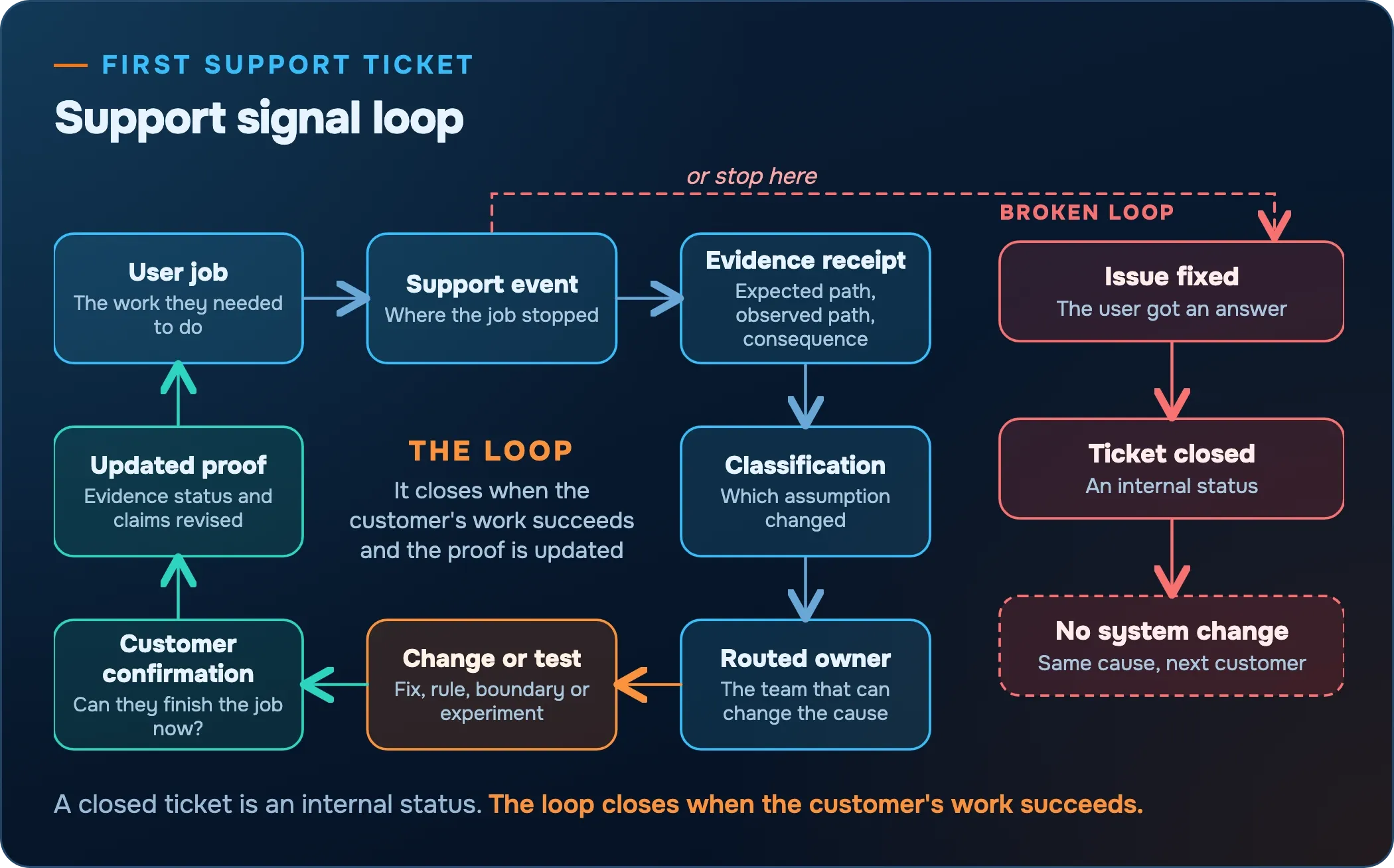
For an early support interaction, capture:
- user job;
- expected path;
- observed path;
- source and environment;
- consequence;
- workaround;
- classification;
- assumption changed;
- decision owner;
- next test or change;
- customer follow-up;
- evidence status.
The classification should route the signal to the team able to change the cause: support documentation, onboarding, product, data and integration, sales and positioning, offer scope, implementation, or ICP.
This is where The Review Loop Is The Real AI Product becomes a company practice, not only an AI feature. Corrections and exceptions create value when they become structured input to the next product or operating decision.
Close the loop with the customer
A closed ticket is an internal status. It is not proof that the workflow now works.
Return to the user after the explanation, fix, or process change. Can they complete the job? Did the workaround disappear? Did the change create a new burden? Has the consequence been resolved, or only the visible symptom?
That check can produce stronger evidence than the ticket itself. It also protects the company from updating a case study, demo, or sales claim before the discovered boundary has actually changed.
For pilots, support evidence should enter the review. A Pilot Needs A Conversion Contract explains why the parties need explicit stop, extension, redesign, and paid-conversion decisions. A recurring support pattern may show that the workflow needs redesign even when the headline metric looks positive.
Review the first five tickets as validation evidence
Take the first five support interactions from a pilot or early deployment. For each one, write two lines:
What assumption changed?
What decision follows?
Then look for one signal that repeats or one high-severity signal that changes the operating boundary. Assign an owner, define the next test, and return to the customer after the change.
Proof Engine’s methodology treats evidence as useful when it changes a decision. The first support ticket deserves the same standard. Solving the immediate issue is part of the job. Learning what the issue says about the product, company, and customer system is the rest of it.
FAQ
Why is the first support ticket a validation event?
It is one of the first unscripted tests of the assumptions behind the product, offer, onboarding, data requirements, ownership model and target segment. The user is no longer reacting to a demo. They are trying to do real work under real constraints.
How should an early support ticket be classified?
By the assumption that changed: promise mismatch, onboarding gap, permission and data gap, product defect or design gap, segment mismatch, or operating-system failure. Routing every ticket to product repairs nothing when the real cause is an overbroad promise, a missing permission or an unclear owner.
Does one ticket justify changing the target segment?
No. One ticket creates a hypothesis. Compare the signal by user role, workflow stage, company type, volume, data condition and consequence, and look for repetition before rewriting the ICP, without dismissing a rare high-severity event.
What is a Support Signal Receipt?
A short record of an early support interaction: user job, expected path, observed path, source and environment, consequence, workaround, classification, assumption changed, decision owner, next test or change, customer follow-up and evidence status. Closing the loop means returning to the user to check that the job now works.
Sources
- Nielsen Norman Group: Service Blueprinting FAQ for using support tickets and interview transcripts as service blueprint inputs.
- Google SRE: Incident Management Guide for postmortems, corrective action items, aggregating postmortem data to find trends, and alerting on symptoms rather than causes.
- Proof Engine blog: A Pilot Needs A Conversion Contract
- Proof Engine blog: Case Studies Need Evidence Levels
- Proof Engine blog: The GTM Motion Is A Product Surface
- Proof Engine blog: The Review Loop Is The Real AI Product
- Proof Engine blog, same series: The First Customer Is A Company-Wide Test, The Old Workflow Needs An Exit Date
- Proof Engine: Methodology