

How to Find First Design Partners for B2B SaaS
Short Answer
To find first design partners for B2B SaaS, start with a narrow customer segment, define what you need to learn from that segment, and offer a structured collaboration that requires real commitment.
A design partner is not a beta user with a nicer title. A beta user may try the product. A design partner helps you learn whether the product should exist for a specific market. They give you access to the workflow, the buyer context, the internal objections, and the moments where the product either creates value or fails.
That is why the goal is not to collect as many design partners as possible. The goal is to find a few who can produce high-quality evidence.
In the broader first traction for a B2B startup system, design partners are one early source of proof. They matter most when they show who will commit, what must be built, and what evidence should guide the next commercial decision.
What a Design Partner Really Does
Good B2B SaaS design partners bring reality in. They show how the workflow actually works, not how the founder imagines it. They reveal who touches the problem, where the data lives, what the current workaround costs, what the buyer worries about, and what would need to happen before the company adopts a new solution.
This is especially important in B2B startup validation because the user and the buyer are often not the same person. A product may delight the operator and still fail with the budget owner. A workflow may look simple in a demo and become tangled inside approvals, permissions, security, handoffs, or reporting needs.
The design partner helps expose those realities early, while the product is still flexible.
When You Need Design Partners
Design partners are most useful when the product depends on context you cannot safely guess from outside. Internal workflow tools, enterprise software, compliance-heavy products, AI systems that require expert review, and multi-stakeholder B2B SaaS products often need this kind of collaboration.
If the product is simple, self-serve, and easy for a buyer to evaluate alone, you may not need design partners. You may be better off selling a paid pilot or a narrow first version directly. But when the product needs workflow access, domain nuance, or repeated feedback from a serious customer, a design partner can be much more valuable than a large group of casual beta users.
Start With the Segment, Not the Partner
Many founders start by asking, “Who do we know who might try this?” That can produce friendly conversations, but it often produces weak evidence.
A better question is: “Which customer segment do we need to understand first?”
The first design partners should resemble the market you want to validate. If the long-term customer is a seed-stage B2B sales team, feedback from a corporate innovation manager or solo consultant may be interesting, but it will not validate the same product. If the product is for legal operations teams with contract review bottlenecks, a general operations leader may not be close enough to the workflow.
The segment does not need to be large. It needs to be sharp. A narrow ICP makes outreach easier, feedback cleaner, and product decisions less noisy.
Create a Design Partner Offer
A design partner relationship should have a shape. If the offer is simply “try our product and give feedback,” the founder is likely to get vague reactions and inconsistent commitment.
The offer should explain what the partner receives and what the partner gives. The partner might receive early access, implementation support, influence on workflow design, founder access, or a discounted pilot. In return, they should commit time, workflow access, recurring feedback, a decision-maker touchpoint, and a clear path to pilot, payment, testimonial, or case study if the product creates value.
This does not need to be heavy or legalistic at the beginning. But it should be explicit. A serious relationship creates better evidence than a casual one.
Make the Commitment Concrete
The easiest way to weaken a design partner program is to leave the commitment vague. If the partner agrees to “try it when they have time,” the founder has no real signal. The startup will wait for feedback, the partner will get busy, and the relationship will slowly become another open thread.
The commitment should be concrete enough that both sides know what will happen next. A useful design partner agreement can be simple: two workflow review calls, access to one current process, feedback on the first usable version, one sponsor conversation, and a decision point after a defined pilot window.
This matters because design partners are not only a feedback channel. They are a learning instrument. If the partner will not share the current workflow, involve the buyer, or commit to a pilot decision, they may be useful for interviews, but they are not yet a design partner.
Should Design Partners Pay?
Payment is a strong willingness-to-pay signal, but it is not the only signal.
Some design partners should pay, especially when the product already solves a painful problem and the company is receiving real value. In other cases, the partner may not pay at first, but they should still commit something meaningful: access, data, stakeholder time, workflow review, implementation support, or permission to use the learning publicly later.
The danger is a one-sided relationship where the partner gets free consulting and the startup gets scattered feature requests. If the partner is not committing anything costly, the signal is weak.
How to Find Them
For early customer acquisition in SaaS, strong sources sit closer to the workflow than startup communities. Founder networks, investor introductions, LinkedIn search, niche groups, job postings, industry newsletters, and public discussions can all reveal companies experiencing the problem.
The outreach should not sound like a generic beta invitation. It should name the problem, show that you understand the context, and ask for a specific conversation. For example, instead of saying “we are building an AI sales tool,” say that you are studying how seed-stage outbound teams recover dormant pipeline and are looking for teams willing to review a narrow workflow.
Specificity is the filter. This is founder-led sales: wrong people ignore it; right people recognize themselves.
The same discipline applies when founders try to turn design partners into first paying B2B customers: first customers for B2B SaaS usually come from a specific segment, a concrete pain, and a clear next step.
Use a Two-Step Outreach Sequence
A design partner search usually works better as a sequence than as one long message. The first message should test recognition: does the person understand the problem, and are they close enough to it to care? The second step should qualify whether they can give useful access.
The first message can be short: name the role, the situation, and the problem. For example: “We are speaking with seed-stage B2B founders whose outbound motion is producing meetings but not enough qualified pipeline. We are looking for a few teams willing to review how they handle dormant accounts and follow-up decisions.” That is more useful than asking whether someone wants to be a beta user.
If they reply, the next step is not a demo. It is a qualification conversation. Ask how the workflow works today, who owns it, what breaks, what they have tried, what happens if the problem continues, and what would need to be true for them to run a pilot. If those answers are specific, the person may be a design partner candidate. If the answers are vague, keep them as market learning, not product direction.
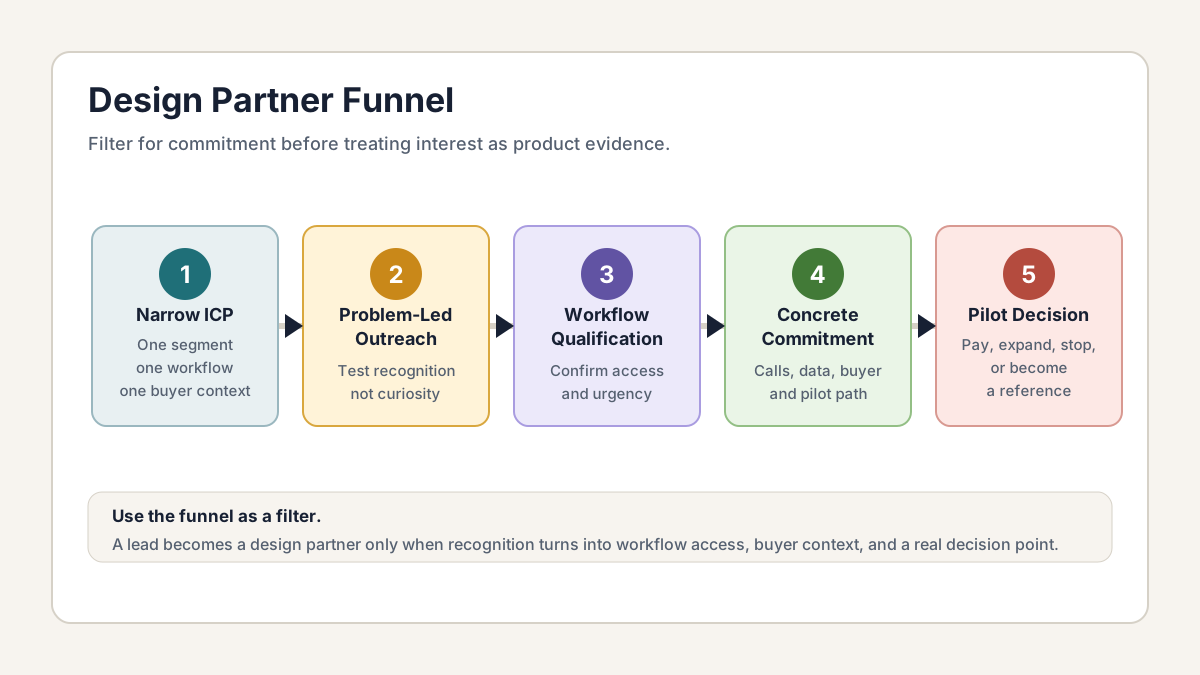
Design partner funnel: use outreach to filter from segment fit to real commitment before treating an account as product evidence.
How to Qualify a Design Partner
A good design partner fits the target ICP, feels the problem now, can show the current workflow, has access to the relevant users or buyer, and is willing to commit time. The best partners also have a credible path to becoming a paid customer.
If someone is curious but not close to the problem, treat them as an interview. If they like the idea but cannot share workflow context, treat them as a weak signal. If they want custom development that would not generalize to the market, be careful. Design partners should help you build a repeatable product, not a private tool for one account.
Score Partners Before You Build Around Them
Not every interested account deserves equal weight. Before letting one design partner pull the roadmap, score the relationship against the evidence you need.
A strong candidate usually scores well across seven dimensions: ICP fit, pain intensity, workflow access, buyer access, speed of response, willingness to commit, and path to payment. A weak candidate may be friendly, senior, or recognizable, but still fail the evidence test. For example, a well-known logo is less useful if the team cannot show the workflow, does not feel the problem now, and has no buyer involved.
The score does not need to be complicated. Use it to protect the product from noise. If three design partners in the same ICP ask for the same workflow support, that is a market signal. If one partner asks for a private integration that no one else needs, that is probably custom work. If a partner gives detailed feedback but never moves toward a decision, they may be an advisor, not a customer.
The goal is not to reject every imperfect partner. The goal is to know what kind of evidence each partner can and cannot produce.
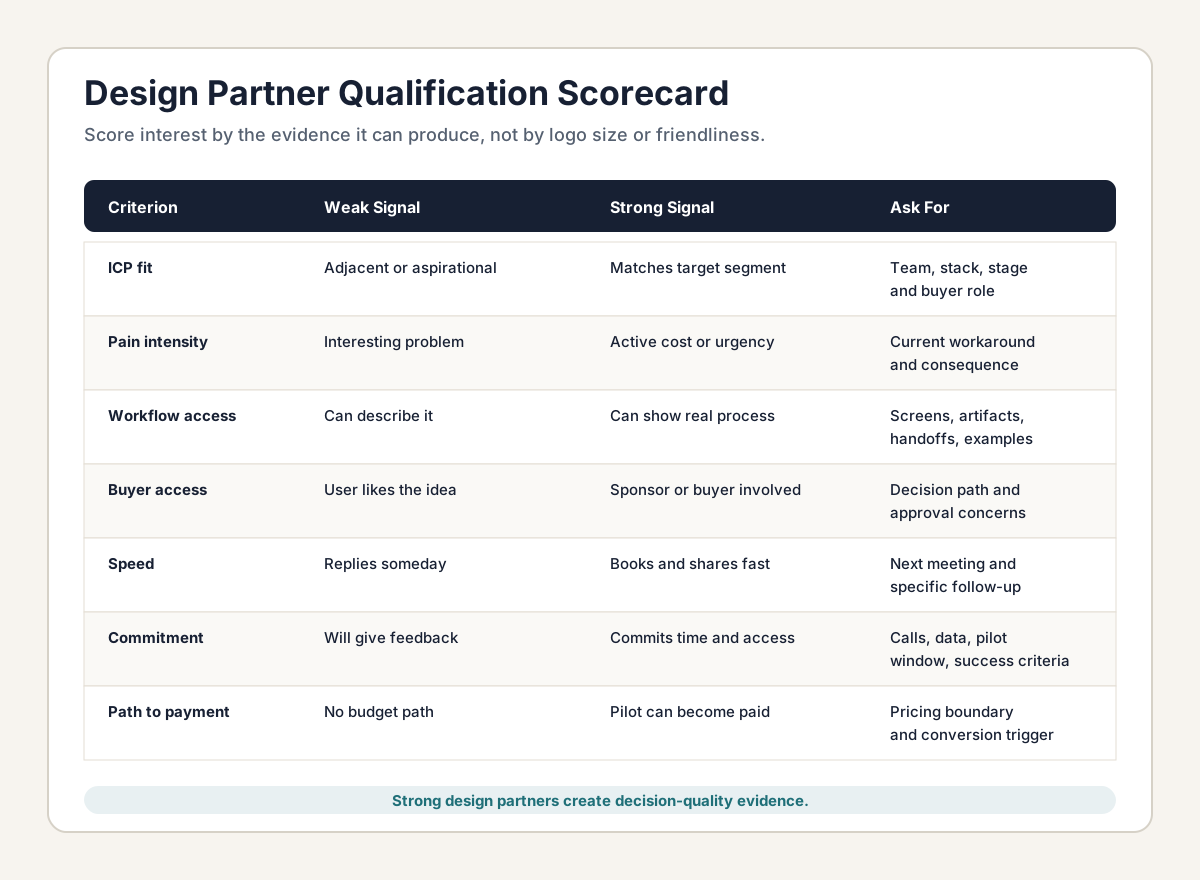
Design partner qualification scorecard: use the same criteria before letting one account shape the roadmap.
Avoid the Custom-Build Trap
Design partners will ask for features. Some requests are gold. Others are traps.
The question is not “did an early customer ask for this?” The question is whether the request reveals something true about the market. If the same need appears across several target accounts, it may be a product signal. If it only matters to one partner’s internal politics, it may be custom work in disguise.
Before building a request, ask whether it is tied to the core workflow, whether it improves activation or payment, whether it generalizes to the ICP, and whether it can be tested manually first. The founder should listen carefully without surrendering the roadmap.
When a request is ambiguous, treat it as one of several demand validation experiments rather than as automatic roadmap input.
What Success Looks Like
A successful design partner program does not always end with a perfect product. It should end with clearer evidence.
You should know which customer segment is most urgent, what workflow creates value, what objections repeat, what a buyer would pay for, what needs to be built next, and what should not be built at all. You should also know whether the partner can become a customer, reference, case study, or source of deeper market access.
If you do not know those things, you may have had conversations, but you have not yet built a design partner system.
FAQ
What is a design partner?
A design partner is an early customer or target account that collaborates with a startup to validate and shape a product before broader launch.
How do you find design partners for B2B SaaS?
Choose a narrow ICP, identify accounts close to the painful workflow, reach out with a specific problem-led message, and offer a structured collaboration with clear commitments.
Should design partners pay?
Payment is a strong signal, but it is not always required. A design partner should at least commit meaningful time, workflow access, stakeholder input, or a credible path to paid conversion.
How many design partners do you need?
For many B2B products, three to five high-quality design partners in one ICP can teach more than a hundred unqualified beta users.
What should a design partner agreement include?
A design partner agreement should define the problem being tested, expected access, meeting rhythm, confidentiality, feedback responsibilities, pilot duration, success criteria, and what happens if the partner wants to become a paying customer.
What is the difference between beta users and design partners?
Beta users test a product. Design partners help validate whether the product should exist for a specific market. They provide deeper workflow context, buyer input, adoption friction, and evidence about what should or should not be built.
How do you qualify design partners?
Qualify design partners by ICP fit, pain intensity, workflow access, decision-maker involvement, speed of response, willingness to commit time, and credible path to paid conversion. Friendly access alone is not enough.
When should a design partner become a paid customer?
A design partner should move toward payment when the product is solving a valuable problem, the customer has used or tested the workflow, and the next stage requires deeper implementation, priority support, or continued access.
Next Step
If you have validation signals but no customer proof yet, the First Paying Customers Program is the closest Proof Engine offer path. Start with a narrow design partner search. The goal is not to collect beta users. The goal is to learn which customer segment will commit, use, pay, and help shape a product that can scale beyond the first account.