

What Startup Traction Metrics Do Investors Care About Before Seed?
Short Answer
Before seed, investors care about traction metrics that reduce the biggest risk in the business.
That means there is no universal “best” metric. A pre-product company, a validation MVP, and a startup with early revenue should not all show the same evidence. The metric matters because of what it proves. If the biggest risk is demand, investors want to see market response. If the biggest risk is product value, they want to see activation or repeated use. If the biggest risk is go-to-market, they want to see qualified pipeline, buyer urgency, and sales learning.
The best traction metric is the cleanest signal. Pre-seed traction metrics should be chosen by risk.
In an investor-ready evidence system, each metric should explain what became less risky and what still needs to be proven after the round.
Why Early Traction Looks Different
Pre-seed and seed companies live in uncertainty. The product may be narrow. The sales motion may be founder-led. Revenue may exist, but it may be early, uneven, or tied to pilots.
The mistake is pretending the company is more mature than it is. Vanity metrics make the investor work harder to find the truth. Explaining which risk is being reduced sounds much more credible.
Early traction is not about proving that everything works. It is about proving that something important is becoming less risky.
Start With the Risk, Not the Metric Category
The most useful way to choose startup traction metrics is to start with the investor’s main doubt.
If the company is pre-product, the doubt may be whether the problem is real and urgent. If the product exists but revenue is early, the doubt may be whether the right users reach value. If the team has pilots but no repeatable sales motion, the doubt may be whether first revenue can become a GTM system. If the company is entering a new segment, the doubt may be whether traction in one market transfers to another.
This is why copying another startup’s traction slide rarely works. Two companies can show the same metric and mean very different things. Ten design partners can be strong if they are in one narrow ICP with workflow access and pilot commitments. They can be weak if they are scattered across unrelated segments and only agreed to “give feedback.” A small paid pilot can be strong if it comes from the target buyer and matches the future business model. Early revenue can be weak if it is custom services with no repeatable product path.
Before choosing what to show, write the risk in one sentence: “The main thing we need investors to believe now is…” Then select the metric that makes that belief more credible.
That is the same reason proof before build matters. The team should not choose a metric because it looks impressive. It should choose the metric that proves the next expensive commitment is justified.
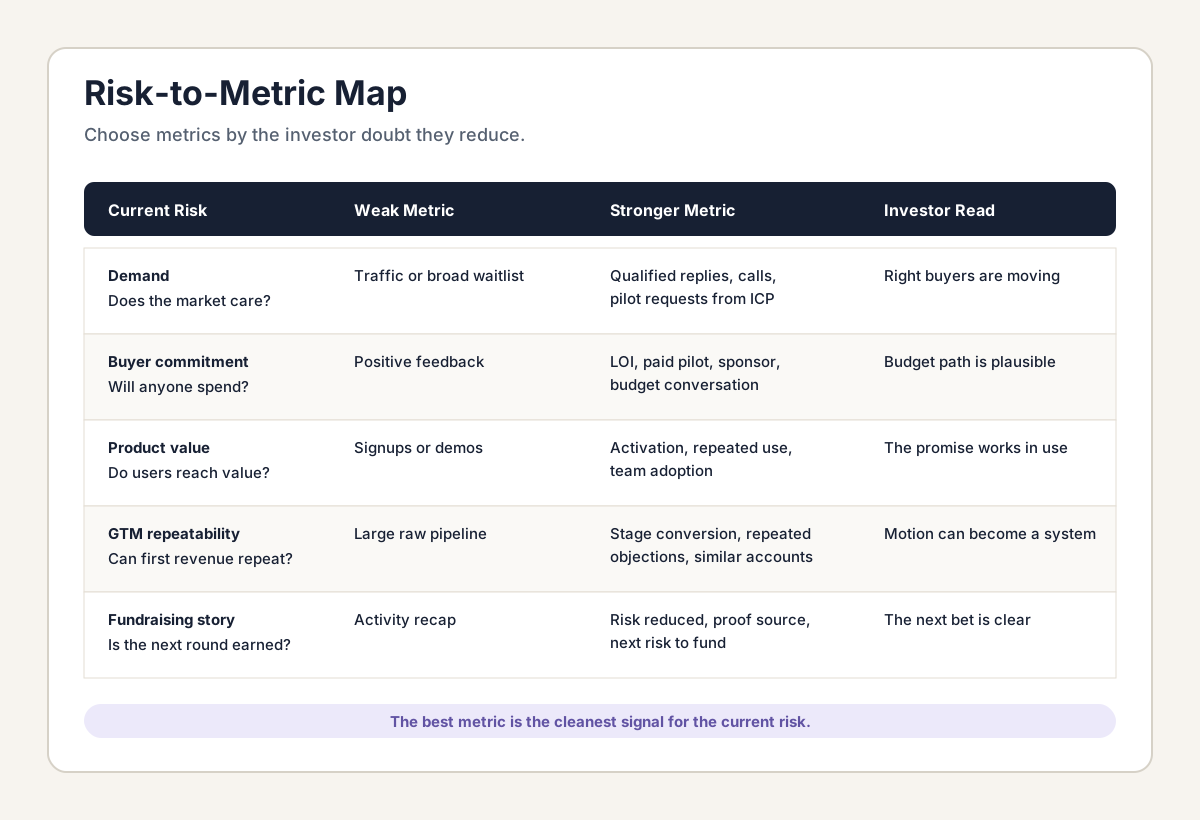
Risk-to-metric map: investors read metrics by the doubt those metrics reduce.
Demand Metrics
Demand metrics matter when the company still needs to prove that the market cares. Structured demand validation experiments can turn vague market interest into behavior that is easier to interpret.
For B2B startups, this often starts with target-customer behavior. Are the right buyers replying? Are they describing the problem without being coached? Are they booking calls from a specific offer? Are they asking about pilots, implementation, pricing, or internal stakeholders?
A small number of high-quality conversations can be more useful than a large number of generic signups. Investors know this. A waitlist of 1,000 people means less if none of them match the buyer. Ten qualified calls from a narrow ICP may say much more.
Design Partner Metrics
Design partners matter when the product needs close collaboration before it can be shaped properly. The important question is not only how many design partners you have. It is who they are and what they have committed.
A strong B2B SaaS design partner matches the ICP, feels the problem urgently, gives workflow access, involves relevant stakeholders, and has a path to paid conversion. A weak design partner is merely curious.
In a pitch deck, it is better to say, “We have three design partners in the target segment, each giving workflow access and meeting weekly around a defined pilot path” than to say, “We have 20 beta users.” The first sentence has evidence. The second may only have activity.
Paid Pilot and Revenue Metrics
Paid pilots are often one of the strongest early B2B signals because they combine demand, budget, and workflow seriousness. They show that a buyer is willing to spend money and attention before the product is fully mature, which makes them stronger than a generic willingness-to-pay test with no implementation path.
First revenue is even stronger when it comes from the intended customer and maps to the future business model. It is weaker when it comes from one-off custom work that cannot repeat.
Investors will usually want context. Who paid? Why did they pay? How long did the sale take? What was promised? How much work did delivery require? Could the same offer sell to another similar account?
Revenue without context can be misleading. The best version explains the conversion path, not just the amount. “We converted two target accounts into paid pilots after 18 qualified conversations” shows a learning loop. “We made $8,000” may still leave the investor guessing whether the money came from product demand, consulting, founder favors, or a one-off relationship.
For early B2B companies, quality beats size. First revenue should teach the team something about urgency, budget, sales cycle, implementation, usage, and repeatability.
Product Usage Metrics
If the company has a validation MVP or early product, investors will want to know whether users reach value. Activation matters because it shows that the product promise is becoming real. This is one early input into evaluating product-market fit with early data, even before the company has a mature PMF story.
The activation event should be specific to the product. For an AI workflow, it may be accepting an AI-assisted output. For a data product, it may be connecting a source and generating the first useful report. For a sales tool, it may be sending the first campaign or reviving the first account.
Repeated use matters even more. A user who returns to complete the workflow again is giving a stronger signal than a user who only explored once. Before product-market fit, repeated use from a narrow target segment can be more meaningful than broad casual usage.
Pipeline Metrics
Pipeline can help or hurt a fundraising story. A large pipeline number with no qualification often sounds inflated. A smaller pipeline with clear stages, buyer roles, next steps, and repeated objections is more useful.
Investors want to know whether the pipeline reflects real buying motion. Are the accounts in the target ICP? Is there a budget owner? Is there a next step? Did the opportunity come from a repeatable channel? What objection is slowing it down?
A good pipeline slide should show learning, not just hope. The same pipeline discipline matters when the company is trying to turn outreach into first paying B2B customers.
Use an Evidence Ladder
Traction becomes more convincing when the signals form a ladder. Each rung should be stronger than the one before it.
For a B2B startup before seed, the ladder often starts with problem confirmation: the right people describe the pain in their own words. Then it moves to demand: they reply, book calls, ask buying questions, or request a pilot. Then it moves to commitment: they share workflow access, introduce stakeholders, sign an LOI, pre-order, or pay for a pilot. Then it moves to product value and repeatability: users activate, repeat the workflow, and similar accounts move through similar steps.
One rung is not enough to prove the company. But the pattern matters. If every signal points in the same direction, the story becomes easier to believe. If the signals conflict, the founder should explain the conflict directly. For example, high usage with no buyer urgency means the company may have user value but weak budget. Strong buyer interest with low activation means the company may have demand but not enough product value yet.
This is the kind of clarity investors look for. They do not expect perfection before seed. They expect the founder to know what the evidence means.
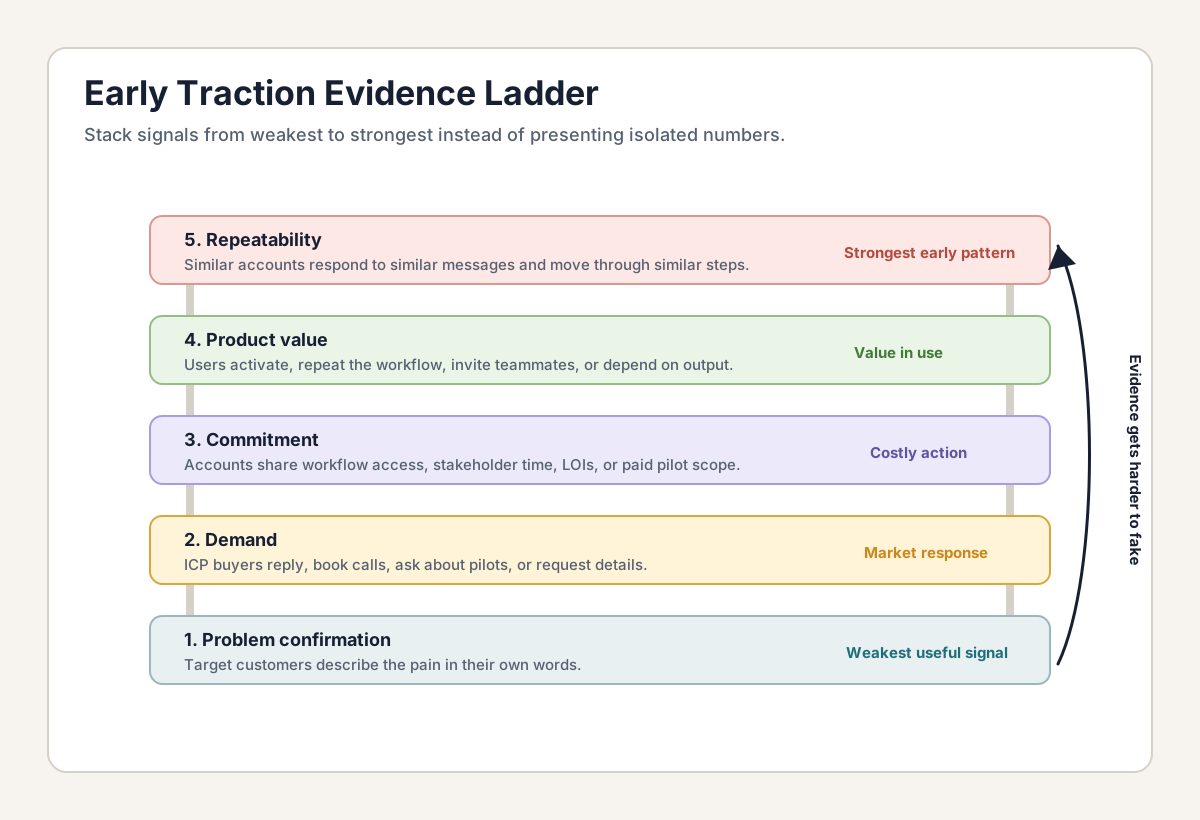
Early traction evidence ladder: each rung should make the next investment decision easier to believe.
Learning Velocity
Learning velocity is one of the most underrated early traction signals.
Before seed, investors may fund a team because it is learning quickly in a valuable market. That does not mean “we are moving fast.” It means the team can name the assumptions it tested, the segments it rejected, the product changes it made, and the evidence that improved after those changes. When the learning is tied to buyer behavior, it can become fundraising traction.
Learning velocity is especially useful when revenue is early. It shows that the company is not wandering. It is narrowing.
Metrics That Usually Look Weaker Than Founders Think
Some metrics can support the story, but should not carry it. Website traffic, social impressions, press mentions, unqualified waitlists, demo views, and generic survey results can all create a sense of motion without proving market pull.
They are not worthless. They may show awareness, message resonance, or top-of-funnel curiosity. But if they are not tied to the target buyer and the next decision, they should stay in the background.
Can You Raise Before Revenue?
Yes, but the evidence has to be appropriate for the stage.
A pre-revenue B2B startup may still have a credible seed story if it can show acute customer pain, qualified demand, design partner commitments, pilot requests, validation MVP usage, strong founder-market fit, or a fast learning loop. The founder should be honest about what is not proven yet and precise about what the round will prove next.
Investors do not need every risk removed. They need to believe the next risk is worth funding.
How to Put Metrics in a Pitch Deck
A strong traction slide gives context. It names the target customer, the signal, the quality of that signal, the time period, and what changed because of the evidence.
“500 waitlist signups” is weak by itself. “In 21 days, we contacted 120 target accounts, booked 14 qualified calls, secured 3 design partner commitments, and converted 1 into paid pilot scope” is much stronger. It tells the investor who moved, how they moved, and why it matters.
The best traction slides do not try to make the company look bigger. They make the next investment look earned.
When possible, support the slide with public-safe case studies or proof narratives that show what changed because of the evidence, not just what activity happened.
FAQ
What traction metrics matter before seed?
For B2B startups, investors often care about ICP-specific demand, design partners, paid pilots, first revenue, activation, repeated use, qualified pipeline, and learning velocity.
Can a startup raise before revenue?
Yes, if it has strong evidence that reduces the current risk, such as buyer demand, design partner commitments, pilot requests, validation MVP usage, or unusually strong customer pain.
Is a waitlist good traction?
A waitlist can be useful, but it is stronger when it comes from the target customer, follows a clear offer, and converts into conversations, pilots, or usage.
How to show traction in a pitch deck before revenue
Use metrics tied to the current risk: demand, buyer commitment, activation, usage, pipeline, or learning. Include context and explain what the evidence changed.
What is the strongest pre-seed traction signal?
The strongest pre-seed signal is usually behavior from the exact target customer that reduces the main risk. For B2B startups, that may be paid pilots, design partner commitments, repeated usage, qualified pipeline, or a clear buyer path to budget.
Do investors care about revenue or usage more?
It depends on the business and stage. Revenue is a strong commercial signal, but usage can matter more if the current risk is product value or adoption. The best metric is the one that proves the next important assumption.
How should B2B startups show pipeline before seed?
B2B startups should show pipeline with context: target account quality, stage, source, buyer role, problem urgency, next step, and conversion from outreach to conversation to pilot or paid scope. Raw pipeline value alone can be misleading.
What metrics are vanity metrics before seed?
Vanity metrics include broad traffic, unqualified signups, social engagement, downloads, and waitlist size when they are not tied to the ICP, buyer intent, product usage, or revenue path. They can add context, but they should not carry the traction story.
Next Step
Before building the traction slide, map each metric to the risk it reduces. If a metric does not support a decision, it may belong in the appendix or not at all. Investor ready traction evidence is not about making the company look bigger. It is about making the next investment look earned. If the evidence is still messy, start from the Validate route and use Product Packaging & Investment Narrative as an add-on only after the proof is real.