
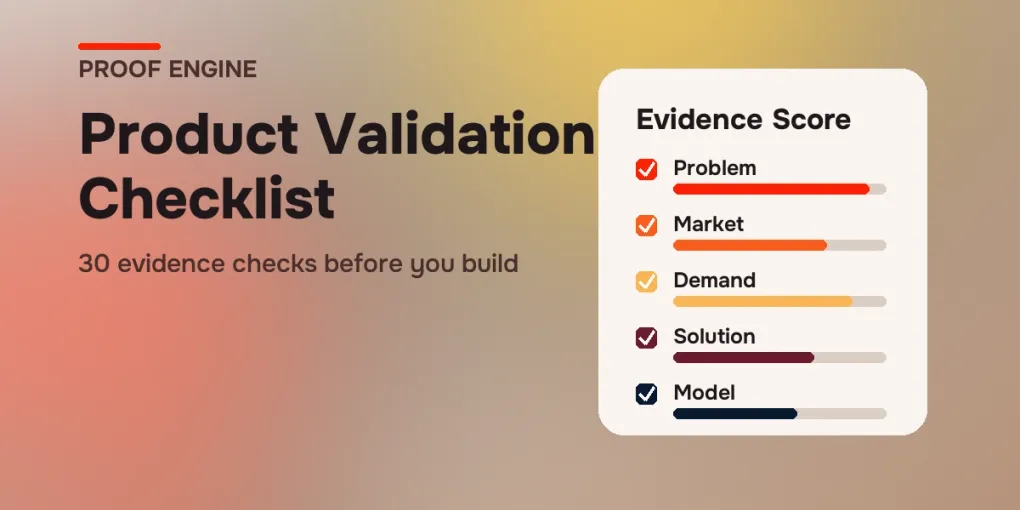
Product Validation Checklist for Startups
Most founders validate by instinct. They talk to a few people, hear encouraging feedback, and start building. Six months later, they discover that “positive feedback” did not become paying customers.
This checklist fixes that.
It gives you a 30-point way to score whether your idea is ready to build. Each item forces a specific piece of evidence: interview data, market proof, demand behavior, pricing signal, usability signal, or business model logic.
Use it before you commit to an MVP, before you hire a product team, before you pitch the idea as validated, or after an early product launches without traction.
Quick Answer: What Is a Product Validation Checklist?
A product validation checklist is a structured list of evidence a founder should collect before building or scaling a product. A useful checklist covers five areas: problem validation, market validation, demand validation, solution validation, and business model validation.
The goal is not to get a perfect score. The goal is to see where the evidence is strong, where it is weak, and what experiment should happen next.
If you need the full process behind the checklist, start with how to validate a startup idea. If you want the scoring model, use the startup idea validation framework.
How to Use This Checklist
Score Evidence, Not Confidence
For each item, use this scoring system:
| Score | Meaning | Evidence Standard |
|---|---|---|
| 1 | Done | You have documented evidence from real target customers or market data |
| 0.5 | Partially done | You have partial evidence, but it is incomplete, biased, or not yet tested enough |
| 0 | Not done | You have not tested this item or only have assumptions |
Be strict. “I believe this” is not evidence. “Three prospects said this in interviews, and two agreed to a paid pilot conversation” is evidence.
Interpret the Final Score
| Score | Decision Read | What It Usually Means |
|---|---|---|
| 25-30 | Strong go signal | You have enough evidence to start a focused MVP or pilot |
| 18-24 | Conditional go | The idea has promise, but one or more risk areas need more testing |
| Below 18 | Do not build yet | Too many assumptions remain untested |
The score should guide the next experiment, not replace judgment. A 24 with no willingness-to-pay evidence may still be risky. A 19 with a signed LOI from the exact customer segment may be stronger than it looks.
Keep an Evidence Log
As you work through the checklist, keep a simple evidence log:
| Item | Evidence Collected | Source | Date | Confidence |
|---|---|---|---|---|
| Problem frequency | 14 of 18 interviewees reported weekly pain | Interview notes | YYYY-MM-DD | High |
| Demand signal | 37 waitlist signups from 612 paid visitors | Landing page analytics | YYYY-MM-DD | Medium |
| Pricing signal | 2 prospects accepted paid pilot range | Sales calls | YYYY-MM-DD | High |
This prevents validation from becoming a pile of vibes. It also gives co-founders, advisors, investors, or agencies something concrete to review.
Section 1: Problem Validation (8 Points)
This section answers: Is there a real, painful problem worth solving?
Item 1: Defined the target customer in one sentence. Write it as: “[Role] at [company type] who [specific context].” If your definition includes “everyone,” narrow it.
Item 2: Identified 3+ channels where target customers gather. These can be communities, forums, newsletters, Slack groups, LinkedIn segments, events, partner channels, or search queries. You need reachable customers, not just theoretical customers.
Item 3: Conducted 10+ problem discovery interviews. The interviews should be with people who match the target segment. Ask about past behavior, current pain, current workarounds, and consequences. Do not lead with your solution.
Item 4: Confirmed the problem is frequent or high-consequence. Weekly pain is strong. Daily pain is stronger. Infrequent pain can still matter if the consequence is severe: lost revenue, churn, compliance risk, operational failure, or personal stress.
Item 5: Confirmed the problem is painful enough to motivate action. Look for pain rated 7+/10, urgent language, emotional intensity, or clear business impact. Mild annoyance rarely becomes a startup.
Item 6: Confirmed people currently spend money or time solving this. Current spending can mean software, agencies, consultants, internal labor, spreadsheets, manual operations, or opportunity cost. No current workaround is a warning sign.
Item 7: Identified existing alternatives and their shortcomings. List at least 3 alternatives. Include direct competitors, indirect substitutes, and manual workarounds. Explain why each fails for your target segment.
Item 8: Wrote a falsifiable problem hypothesis. Use this format: “[Customer] has [problem] because [root cause], costing them [impact].” Then write what evidence would disprove it.
Section 1 Score: ___ / 8
Section 2: Market Validation (6 Points)
This section answers: Is the market big enough, reachable enough, and timely enough?
Item 9: Estimated bottom-up TAM with real data. Use customer counts and realistic pricing. Avoid top-down claims such as “this is a $10B market” unless you can connect that market to your actual segment.
Item 10: Estimated reachable market for the next 12-24 months. Your first market is not everyone who could ever buy. It is the group you can actually reach through channels you can afford.
Item 11: Mapped 5+ competitors or substitutes. A healthy market usually has alternatives. If you cannot find any, check whether you are using the customer’s language or only your own product language.
Item 12: Identified competitive gaps or underserved segments. Name what existing solutions miss: price, speed, integration, trust, workflow fit, support, specialization, or distribution.
Item 13: Checked regulatory, legal, and trust constraints. This matters especially for fintech, healthtech, edtech, dating, AI automation, data-heavy products, marketplaces, and anything touching sensitive user information.
Item 14: Articulated why now. A strong idea usually has a timing reason: technology shift, regulatory change, new behavior, budget pressure, platform change, AI capability, or market transition.
Section 2 Score: ___ / 6
Section 3: Demand Validation (8 Points)
This section answers: Will people act, commit, or pay?
This is where many ideas break. People can agree that a problem exists and still refuse to buy the solution. Demand validation tests behavior.
For experiment options, see 7 demand validation experiments for startups.
Item 15: Built a smoke-test landing page. The page should describe the outcome, target customer, problem, offer, and call to action. It does not need to be a full product site.
Item 16: Sent targeted traffic to the page. Use paid ads, organic community posts, cold outreach, warm intros, newsletter placements, or partner channels. Track traffic source quality, not just volume.
Item 17: Measured conversion against a predefined threshold. Define the pass/fail threshold before launch. Track email signup, waitlist join, demo request, “buy” click, pricing click, or application submission.
Item 18: Ran a second demand experiment beyond the landing page. Examples: fake-door test, cold outreach, pre-sale, LOI campaign, concierge MVP, paid pilot, crowdfunding, or manual service offer.
Item 19: Collected 10+ concrete expressions of purchase intent. Concrete intent includes detailed replies, demo requests, calendar bookings, pricing questions, pilot requests, procurement questions, or waitlist joins with context.
Item 20: Received at least one high-commitment signal. This can be a pre-order, deposit, signed LOI, paid pilot, founder-led concierge payment, or serious B2B buying process.
Item 21: Tested willingness to pay at the target price range. Ask for commitment near the price you actually plan to charge. “Would you use this for free?” does not validate a business.
Use test willingness to pay before writing code for methods and examples.
Item 22: Documented all demand signals with source data. Keep screenshots, analytics exports, call notes, email replies, payment records, CRM notes, and source links. Anecdotes fade. Evidence compounds.
Section 3 Score: ___ / 8
Section 4: Solution Validation (5 Points)
This section answers: Can your proposed solution solve the problem in a way customers understand and value?
Item 23: Created a solution mockup, prototype, or concierge version. This can be a clickable prototype, landing page walkthrough, manual service, spreadsheet-backed process, Figma flow, AI-assisted workflow, or no-code version.
Item 24: Tested the solution with 5+ target users. Watch people use or react to the solution. Do not over-explain. Confusion is data.
Item 25: Achieved 80%+ core-task success in usability testing. If users cannot complete the primary workflow without hand-holding, the MVP scope or UX needs work before build investment increases.
Item 26: Confirmed the solution addresses the original pain point. A product can be interesting and still solve the wrong problem. Make sure user feedback maps back to the problem hypothesis from Section 1.
Item 27: Identified the single feature or workflow that creates the most value. This becomes the MVP core. Everything else is a candidate for later.
Section 4 Score: ___ / 5
Section 5: Business Model Validation (3 Points)
This section answers: Can this become a sustainable business?
Item 28: Estimated unit economics. Estimate customer lifetime value, gross margin, acquisition cost, service cost, and payback period. Even rough math is better than ignoring economics until after launch.
Item 29: Identified and tested the primary revenue model. Subscription, transaction fee, usage-based pricing, services, marketplace take rate, one-time purchase, implementation fee, or enterprise contract. Pick the model and test whether the customer accepts it.
Item 30: Built a 12-month projection with assumptions documented. Keep it simple: revenue, costs, runway, conversion assumptions, acquisition assumptions, and delivery cost. Every assumption should trace back to validation data or a stated unknown.
Section 5 Score: ___ / 3
Scoring Your Results
Add the five section scores.
25-30 Points: Strong Go Signal
You have validated the problem, market, demand, solution, and business model well enough to build a focused MVP or pilot.
Do not treat this as permission to build every feature. Build the smallest version that delivers the core value identified in Item 27. Keep the evidence close. The best MVP scope is the one validation already earned.
18-24 Points: Conditional Go
The idea may be worth pursuing, but the gaps matter. Look at the weakest section first.
Common patterns:
- Strong problem score, weak demand score: People complain but do not act.
- Strong demand score, weak solution score: The offer resonates, but the workflow is not clear yet.
- Strong solution score, weak business model score: Users like it, but pricing or acquisition may fail.
- Strong market score, weak problem score: The category is large, but your specific wedge is not painful enough.
Run the next cheapest experiment that directly attacks the weakest pillar.
Below 18 Points: Do Not Build Yet
This is not failure. It is the checklist doing its job.
Below 18 usually means too many assumptions remain untested. Go back to the lowest-scoring section. If the problem score is weak, run more interviews. If the demand score is weak, run stronger action-based tests. If the business model score is weak, pressure-test pricing and acquisition before building.
What to Do With the Checklist Result
If the Score Says Build
Translate the strongest evidence into MVP scope:
- Who is the first user segment?
- What job are they hiring the product to do?
- What feature or workflow creates the most value?
- Which demand signal should the MVP amplify?
- What metric will prove the MVP is working?
Then read build an MVP or validate first if you still need to decide how much product to build.
If the Score Says Pivot
Do not throw everything away. Look for where evidence was strongest:
- Did one segment respond better than another?
- Did one pain point repeat more often?
- Did one message convert better?
- Did one pricing model create less resistance?
- Did users ask for a different outcome?
Pivot around evidence, not panic.
If the Score Says Stop
Stopping early is a valid outcome. The best time to kill a weak idea is before it absorbs months of product work, brand work, fundraising energy, and founder identity.
Use the learning. Your next idea starts with better pattern recognition.
Checklist Summary
| Section | Points | Core Question |
|---|---|---|
| Problem Validation | 8 | Is the pain real and urgent? |
| Market Validation | 6 | Is the opportunity reachable and timely? |
| Demand Validation | 8 | Will people act or pay? |
| Solution Validation | 5 | Can the solution deliver clear value? |
| Business Model Validation | 3 | Can this become a business? |
| Total | 30 | Should we build, pivot, or stop? |
Want Someone to Run the Checklist With You?
Completing all 30 items on your own can take 4-8 weeks of focused work. In a Proof Engine sprint, we run the checklist as a 2-week evidence process: interviews, market research, demand experiments, scoring, and a go/pivot/stop recommendation.
What you get:
- All five validation areas pressure-tested
- Documented evidence, not memory-based notes
- 3-5 live demand experiments where appropriate
- AI-assisted research and synthesis
- A clear recommendation and next-step roadmap
Book a Free 15-Minute Fit Call
Not ready to talk? Start with how to validate a startup idea, then pick one test from 7 demand validation experiments.
FAQ
What is the difference between product validation and market research?
Market research describes the category. Product validation tests whether your specific customer, problem, offer, price, and solution can produce real demand.
How many customer interviews are enough?
For early validation, 10-20 interviews with the right segment usually reveal useful patterns. Interviews alone are not enough, though. Pair them with demand experiments that require action.
What is a good validation score?
25-30 is a strong go signal. 18-24 is conditional and needs targeted follow-up. Below 18 means you should not build yet.
Can I use this checklist after launching an MVP?
Yes. It is especially useful when an MVP has little traction. The checklist helps diagnose whether the issue is problem, audience, demand, solution, pricing, or business model.
Proof Engine Studio is an AI-native product validation studio. We run two-to-four-week validation sprints that give founders real demand signals, not opinions.