

Your SQL Ran. Your KPI Is Still Wrong.
Why cross-engine analytics needs a result-consistency check—not another SQL validator.
Imagine asking one business question:
What was net revenue last month?
One analytics assistant generates Trino SQL. Another generates ClickHouse SQL. Both query the same Iceberg-backed data. Both queries execute successfully. Both dashboards look plausible.
One says 42.7 million. The other says 41.9 million.
Which answer reaches the decision-maker?
Usually, the one with the better chart.
The numbers above are only an illustration, but the failure mode is real in structure: syntactically valid SQL is not the same as semantically equivalent SQL.
Same Table Does Not Guarantee the Same Answer
Open table formats solve an important problem: multiple engines can read shared data and metadata. But storage consistency sits one layer below analytical result consistency.
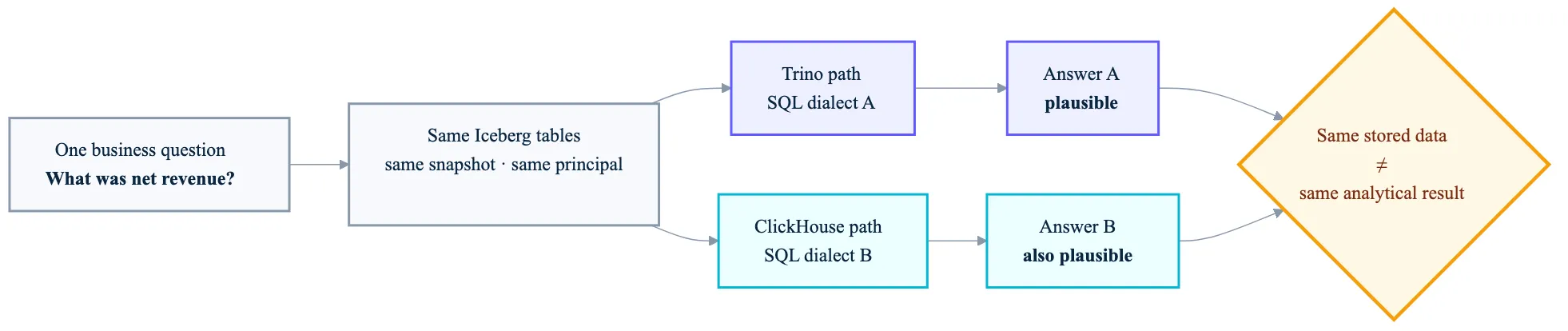
Figure 1 — Same stored data does not guarantee the same analytical result.
Two engines can read the same snapshot and still disagree because of:
- different
NULLhandling - timezone and date-function defaults
JOINsemantics and implicit casts- window-frame defaults
- decimal and timestamp representation
- unstable ordering or top-K ties
- engine-specific functions such as
argMaxandMAX_BY
AI-generated SQL makes this boundary more visible. An assistant optimizes for producing executable code in a target dialect. “The query ran” is a useful signal, but it does not prove that another valid implementation of the same logical question would return an equivalent result.
That is why this problem cannot be reduced to SQL linting.
What a Useful Consistency Check Should Do
A cross-engine validator should not blindly translate a query, run it twice, and compare two CSV files. That creates false confidence.
It needs a controlled evidence path.
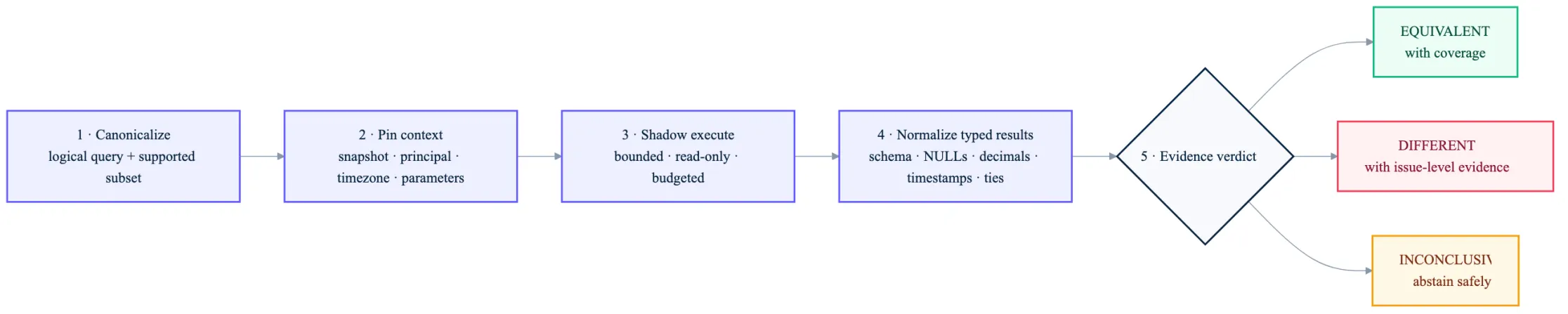
Figure 2 — A controlled evidence path for cross-engine comparison.
1. Canonicalize the Logical Question
Start with a supported query subset and a canonical representation of the intended aggregation, filters, dimensions, grain, and metric definition. Do not assume one dialect is the universal source of truth.
2. Pin the Execution Context
The snapshot, principal, timezone, parameters, catalog state, and contract version must be identical. Otherwise, the comparison mixes semantic drift with environmental drift.
3. Use Bounded Shadow Execution
Alternate-engine execution should be read-only, policy-controlled, and constrained by time, rows, bytes, and cost. Expensive checks belong on high-stakes workflows or asynchronous audits—not every exploratory query.
4. Normalize Typed Results Before Comparison
Schema, ordering, NULL values, decimals, timestamps, and ties need canonical treatment. Comparison should happen on typed results or local digests, not formatted strings.
5. Return Evidence, Not a Magic Score
The honest verdict set is small:
- equivalent — within the supported comparison scope
- different — with issue-level evidence
- inconclusive — because a safe comparison was not possible
Coverage matters as much as the verdict.
“Inconclusive” Is a Feature
Validation products are tempted to turn uncertainty into a green checkmark. That is exactly the wrong incentive for high-stakes analytics.
If snapshots cannot be aligned, dialect semantics fall outside the supported subset, or a tie cannot be compared safely, the system should abstain. Unknown must remain unknown.
The goal is not to block every answer. The goal is to make the evidence boundary visible before a plausible result becomes a business fact.

Illustration — From plausible disagreement to a reviewable evidence trail.
The Narrow Product Idea We Are Testing
This is one specific part of OVL: a planned multi-engine consistency check for AI-assisted analytics. The first benchmark scope is intentionally narrow—Trino and ClickHouse over a pinned Iceberg snapshot, with a supported logical-query subset and deterministic typed-result comparison.
OVL is pre-product, so this is a testable architecture hypothesis, not a shipped-product claim. The next proof is a reproducible benchmark: seeded divergences, measured precision and recall, explicit abstention, coverage, latency, and re-execution cost.
The question I want to validate with data teams is simple:
When two engines return different answers to the same business question, how do you discover it today—and how expensive is the reconciliation?
If your stack combines Iceberg with Trino, ClickHouse, Spark, or multiple AI/BI surfaces, I would like to compare failure modes.
FAQ
Why can two engines return different answers from the same table?
Because storage consistency sits below analytical result consistency. The same Iceberg snapshot can produce different numbers through NULL handling, timezone and date-function defaults, JOIN semantics and implicit casts, window-frame defaults, decimal and timestamp representation, unstable ordering or top-K ties, and engine-specific functions such as argMax and MAX_BY.
Is this a SQL linting problem?
No. A linter checks the query; this is about two valid implementations of the same business question disagreeing. AI-generated SQL makes the boundary more visible, because an assistant optimizes for code that executes in a target dialect, and “the query ran” does not prove semantic equivalence.
What should a cross-engine consistency check return?
Three verdicts and nothing fancier: equivalent within the supported scope, different with issue-level evidence, or inconclusive when a safe comparison was not possible. Coverage matters as much as the verdict, and abstaining is the correct output when snapshots or dialect semantics cannot be aligned.
This article was first published on LinkedIn.