

How We Implemented an AI Legal Operations Workflow
Most legal AI conversations start in the wrong place. They start with the model: can it draft a claim, summarize a case, answer a legal question, or replace part of the work? Those questions are understandable, but they usually lead to the wrong implementation path. A law firm does not become more efficient simply because someone gives lawyers access to a powerful model.
In the legal practice we worked with, the real issue was not that lawyers lacked expertise. The issue was that too much of the work moved through fragmented operational steps before a lawyer could make the next decision. Notifications, emails, deadlines, templates, internal follow-ups, status checks, and manual preparation were all part of the same repeated loop. At volume, that loop created delay.
So we did not begin by asking, “What can AI generate?” We began by asking a more useful implementation question: “Where does the work actually slow down, and which part of that work can be prepared safely before human review?”
Quick Answer
The implementation was not a legal chatbot. It was a controlled legal operations workflow designed to turn incoming matter updates into review-ready work. The workflow received a notification, email, or matter update; classified the required action; extracted deadlines and missing information; prepared a task or draft from existing firm patterns; and routed the output to a human reviewer before anything external happened.
That distinction matters. The system was not designed to replace legal judgment. It was designed to reduce the manual load around recognition, preparation, and routing so the legal team could reach the judgment point faster.
The Real Problem Was Operational Latency
In a high-volume legal practice, delay rarely comes from one dramatic bottleneck. It usually comes from dozens of small frictions that repeat every day. A notification arrives and someone needs to interpret it. An email changes the status of a matter. A deadline needs to be found and logged. A filing or response needs to be prepared from an existing template. A lawyer needs enough context to review the next step.
None of those steps is exotic, but at volume they become expensive. The risk is not only missed time; it is accumulated operational drag. Work sits inside inboxes, matter systems, templates, and human memory until someone assembles enough context to move it forward.
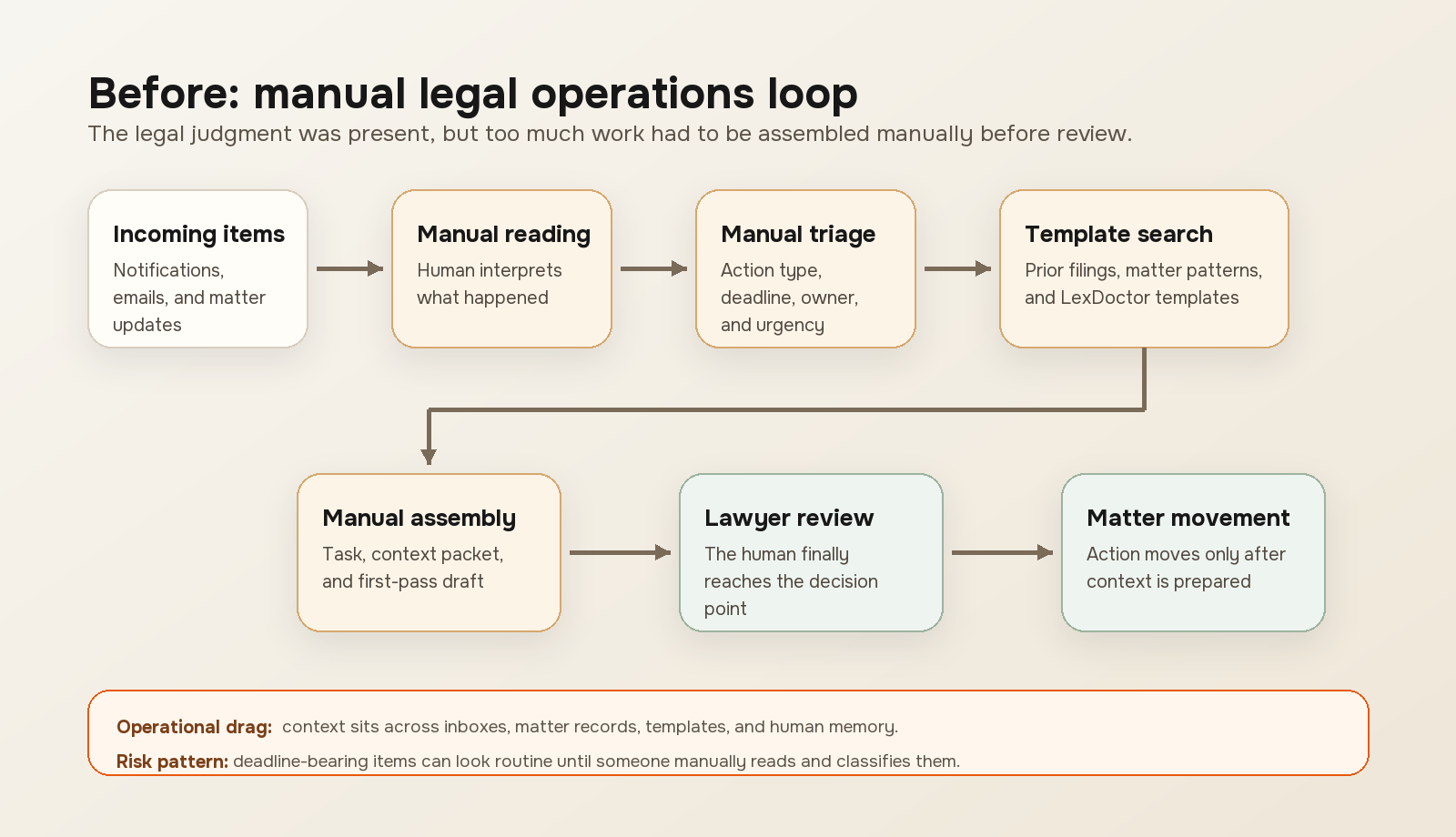
Before the pilot, the workflow depended on humans manually turning scattered inputs into review-ready work. The legal judgment was already there, but too much time was spent before the lawyer reached the judgment point: reading, classifying, checking dates, finding templates, and assembling the next step.
Why We Started With an Assessment Instead of a Build
The source work behind this project started as a legal operations impact assessment, not a product build. That mattered because a weaker implementation would have started with a vague tool idea: “Let’s build an AI assistant for the firm.” That sounds useful, but it does not define what the assistant should receive, what it should produce, who reviews it, what counts as an error, or how the firm will know whether it worked.
The assessment forced the work into a more practical shape. We mapped the firm’s practice profile, matter lifecycle, team structure, recurring document types, notification flow, client-communication load, AI readiness, and governance gaps. We also looked at where informal AI usage already existed, because scattered ChatGPT-style experimentation can create local productivity but still fail to become a reliable operating system.
The result was a narrower and more useful implementation target. Instead of trying to “add AI to the firm,” we selected one repeated workflow where AI could safely reduce preparation time while preserving human control.
The Firm Did Not Need an AI Strategy. It Needed a First Controlled Workflow.
A common mistake in AI adoption is trying to design the full future state too early. For a legal firm, that quickly becomes abstract: AI for research, drafting, client communication, matter management, compliance, and internal knowledge. All of those may eventually matter, but as a first implementation that scope creates risk before it creates proof.
The better question was: what is the first workflow where the firm already has enough structure for AI to be useful? In this case, the selected workflow was centered on notifications, deadlines, and routine draft preparation. That choice was deliberate because the workflow was frequent, operationally painful, grounded in existing templates, and easy to route through human review.
This is the kind of first workflow that makes sense for legal AI. It is not the most theatrical demo, but it is where an implementation can become useful quickly without pretending that the system is making final legal decisions.
The Workflow We Implemented
The pilot workflow had five operating jobs. First, it received an incoming notification, email, or matter update. Second, it classified what kind of action the item appeared to require. Third, it extracted deadlines, missing information, and next steps. Fourth, it prepared a task, review packet, or first-pass draft from the firm’s existing templates and work patterns. Fifth, it routed that output to a human reviewer before any external action.
This made the workflow concrete. The system did not start from a blank prompt, and it did not produce a mysterious answer that someone had to trust blindly. It started from a real operational input and produced a structured packet that a reviewer could inspect, edit, approve, reject, or escalate.
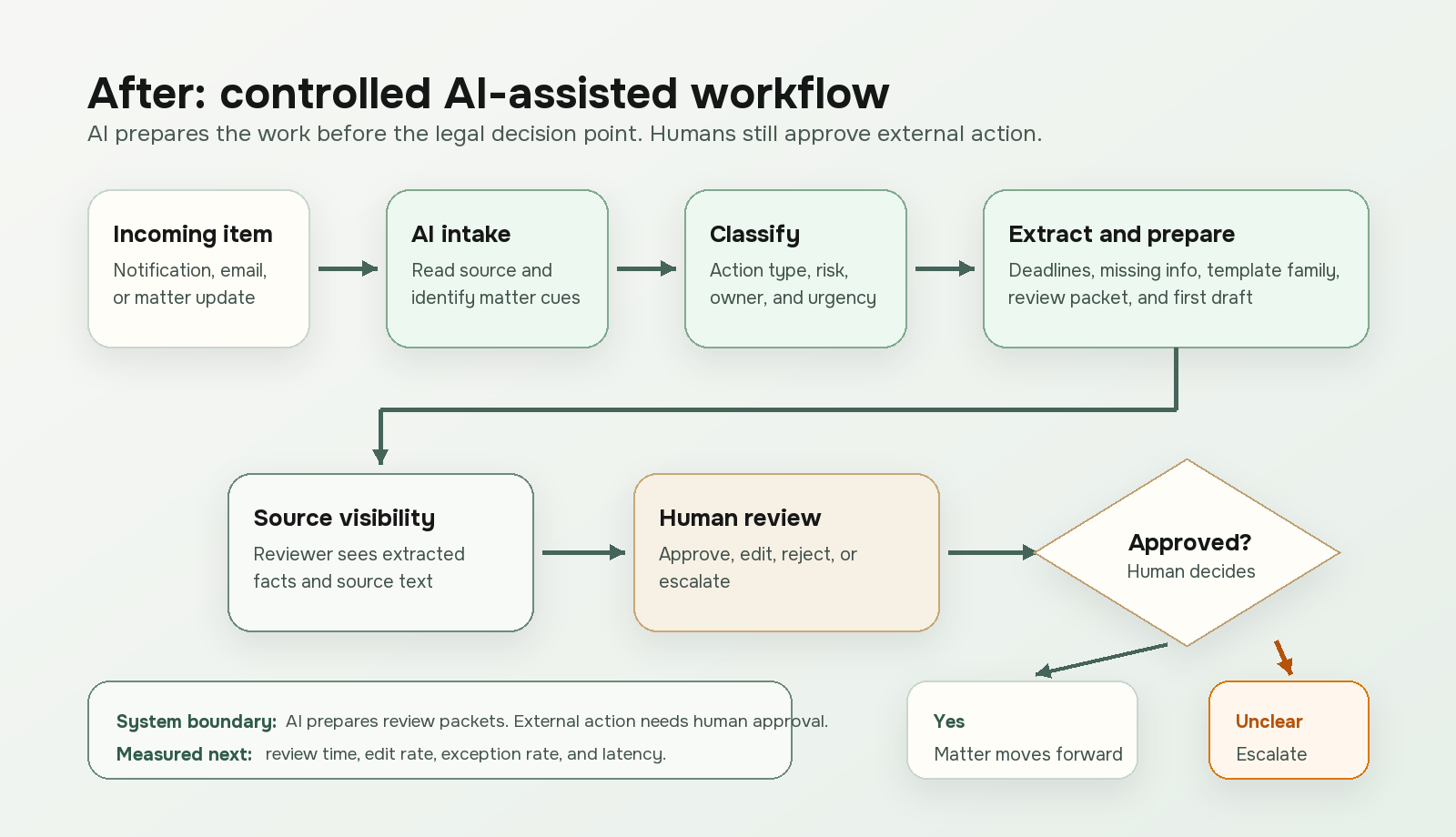
After the pilot, AI sits before the legal decision point. It converts incoming work into structured review packets: what happened, which deadline may apply, what information is missing, which template family is relevant, and what draft or task should be reviewed. The system boundary is explicit: no filing, approval, or external communication without human review.
Example Workflow Run
A realistic workflow run looks like this. A new matter notification arrives in the firm’s inbox or matter-management process. The system reads the notification and identifies it as an item requiring procedural follow-up. It extracts the matter reference, relevant date, apparent deadline, source text, and type of response likely required.
The system then checks the firm’s template patterns for that category of work. Instead of generating a free-form legal answer, it prepares a structured review packet containing a short summary of the notification, the extracted deadline, the supporting source text, a suggested action type, missing information if any, an internal task, and a first-pass draft based on the relevant template family.
The reviewer does not receive “an AI answer.” The reviewer receives a prepared packet that shows what the system saw, what it extracted, what it proposes, and where human judgment is required. That is the practical difference between AI text generation and an AI-assisted legal operations workflow.
LexDoctor and the Existing Stack Were Implementation Context
The firm already had operational infrastructure and knowledge assets, including matter records, templates, prior work product, and existing workflows around LexDoctor. A common implementation mistake would be to treat the current system as something to replace. That is usually the wrong move for a first legal AI pilot because replacement creates integration risk, adoption risk, and unnecessary operational disruption.
The better approach was to treat the existing system of record as context. The workflow could begin around the current stack by mapping matter identifiers, document categories, template families, and review responsibilities. Where a system exposes an API, the production path can use the API. Where it supports import and export, the workflow can map the data structure. Where a local-market tool is more closed, the workflow can use a controlled bridge, RPA layer, or human-in-the-loop handoff.
The implementation principle is simple: do not ask the firm to rebuild its operations before proving value. Start with the workflow the team already runs, add a controlled AI layer around the repetitive preparation steps, and harden integration only after the workflow proves it is useful.
The Human Review Layer Was Part of the Architecture
In legal operations, human review cannot be treated as a cosmetic safety feature. It has to be designed into the workflow from the beginning. The system should behave differently depending on whether the task is low-risk operational support, medium-risk draft preparation, or high-risk legal decision-making.
Low-risk support can include summaries, internal task creation, duplicate detection, template matching, and extraction of dates or matter references. Medium-risk support can include draft preparation, client-response drafts, procedural next-step suggestions, or filing preparation from known templates. High-risk work includes legal argument, strategy, external communication, filing decisions, or anything that could materially affect a client’s position.
That is why the question is not “Do we trust AI?” The better question is: “Which parts of this workflow can AI prepare, and where must human judgment remain explicit?”
| Workflow type | AI role | Human role |
|---|---|---|
| Low-risk operational task | Extract, summarize, classify, prepare task | Quick review or spot-check |
| Medium-risk draft preparation | Prepare first-pass draft from known patterns | Review, edit, approve |
| High-risk legal decision | Surface context and options only | Decide, approve, and own the action |
| Unclear or low-confidence case | Flag uncertainty and escalate | Investigate before action |
This design choice also aligns with the broader ethics reality around generative AI in law. ABA Formal Opinion 512 emphasizes that lawyers using generative AI still need to consider duties around competence, confidentiality, communication, supervision, and reasonable fees. The operational implication is direct: legal AI systems should show their work, preserve review points, and make it clear where the lawyer remains responsible.
The risk is not theoretical. In Mata v. Avianca, lawyers were sanctioned after submitting non-existent cases generated through ChatGPT. Stanford HAI has also reported that legal AI tools can still hallucinate on benchmark legal queries. For a legal practice, the answer is not to avoid AI completely; it is to deploy AI inside bounded workflows where outputs are reviewable before they affect a client, court, counterparty, or public portal.
What the Prototype Proved
The prototype did not prove that a law firm can become fully automated. That was not the goal, and it would be the wrong claim to make. What the prototype proved was more practical: the selected workflow could be decomposed into repeatable steps and supported with AI.
The system could support intake from an incoming operational item, classification of the required action, extraction of dates and matter details, preparation of a structured next-step packet, draft generation from existing templates or patterns, and routing to a human reviewer. That is a meaningful proof point because it turns AI from a general-purpose tool into a workflow component.
It also exposed what would need to be hardened before production use: access control, integration with matter data, template mapping, review queues, logging, exception handling, user feedback, and measurement of accepted, edited, and rejected outputs. That is the difference between a demo and an implementation path. A demo shows that a model can produce text; an implementation path shows how the system behaves when real work, risk, users, and exceptions appear.
What We Deliberately Did Not Claim
For this kind of legal AI project, restraint is part of credibility. We would not claim that the system replaced attorneys, made autonomous legal judgments, or produced measured ROI before the production workflow had enough usage data. We also would not claim that a model can safely handle all legal workflows without review.
The stronger claim is narrower and more defensible: a high-volume legal practice can use AI to reduce operational latency in repeated workflows when the system is grounded in existing templates, connected to matter context, and routed through human review.
That is enough. It is also much more believable.
Proof Signals From the Pilot
The public case study behind this article describes the work as a prototype and pilot buildout, not as a completed production transformation. That boundary matters. The engagement moved the firm from fragmented AI experimentation toward a controlled legal operations workflow, but several production metrics still need to be measured live.
| Proof signal | Status / result |
|---|---|
| Practice type | High-volume legal practice |
| Primary matter areas mapped | 2 |
| Revenue concentration identified | 90% / 10% matter mix |
| Jurisdictions mapped | 3 |
| Core legal system identified | LexDoctor |
| Team sectors and roles mapped | 10+ |
| Recurring task categories mapped | 25+ |
| First pilot workflow selected | Notifications, deadlines, and routine draft preparation |
| Existing template base | LexDoctor templates and firm writing models |
| Prototype status | Implemented |
| Production workflow status | In buildout |
| Human review model | Risk-tiered review gates |
| Integration strategy | Tool-agnostic connector / workflow bridge |
| Next proof gate | Live measurement against baseline triage, drafting, review, accuracy, adoption, and exception metrics |
This is the right level of proof for the current stage. It shows that the workflow was selected, mapped, and prototyped with implementation constraints in mind. It does not pretend that full production reliability or quantified ROI has already been proven.
What We Would Measure Next
The next stage is not “more AI features.” The next stage is measurement. A legal operations pilot should be evaluated by operational proof signals, not generic AI usage metrics.
The useful metrics are concrete: time from notification to review-ready action, number of matter updates processed through the workflow, percentage of outputs accepted or edited by reviewers, review time per item, deadline-bearing items correctly flagged, exception rate, staff adoption, and backlog movement. These metrics connect the AI system to business value without turning early prototype evidence into fake precision.
| Proof signal | Planned proof target |
|---|---|
| Matter updates processed through supervised workflow | 50–100 in pilot window |
| External actions sent without human approval | 0 |
| Review packet completeness | Majority include source, deadline, action type, and next-step recommendation |
| Output review result | Track accepted, lightly edited, heavily edited, rejected |
| Review time per item | Reduce preparation burden versus manual baseline |
| Notification-to-review latency | Reduce time from incoming item to review-ready packet |
| Deadline risk detection | Flag deadline-bearing items consistently for review |
| Template coverage | Identify which matter categories have reusable drafting patterns |
| Exception rate | Track items requiring manual investigation |
| Production decision | Scale, narrow, or redesign workflow based on evidence |
The point is not to make the table look impressive. The point is to make the pilot decision-useful. If the workflow reduces review preparation time but produces too many exceptions, the next step is template mapping and better classification. If the workflow is accurate for one matter type but weak for another, the next step is narrowing scope. If reviewers accept most packets with light edits, the firm has evidence for production hardening.
Why This Approach Works Better Than a Generic Legal AI Rollout
A generic rollout usually starts with access: give the team a tool, let people experiment, and see what happens. That may create local productivity gains, but it rarely changes operations. It can also create governance problems because usage becomes invisible, sensitive information may enter tools without clear rules, and outputs may be trusted inconsistently.
A workflow implementation starts differently. It defines the input, output, risk level, reviewer, system context, success metric, and exception path. That is what turns AI from a toy or side tool into part of the firm’s operating system.
In this project, the value was not that AI could write something. The value was that the firm could move from incoming item to review-ready action with less manual assembly. That is a more useful implementation target because it connects directly to response speed, workload, and matter movement.
The Broader Lesson for Legal Firms
Legal AI adoption should not begin with the question, “Which model should we use?” It should begin with the question, “Which repeated workflow is slowing the firm down?”
The best first workflow usually has five characteristics: it happens often, has recognizable inputs, depends on existing firm knowledge, produces reviewable outputs, and has a clear risk boundary. Notifications, deadlines, and draft preparation fit that pattern. So do intake triage, client update preparation, document checklisting, matter status summaries, template-based draft assembly, internal research packets, and procedural follow-up queues.
The right workflow depends on the firm, but the implementation logic is consistent. Start with repeated work, ground the system in existing context, keep humans in control, and measure whether the workflow actually improves.
What This Means for the Business Model
For a high-volume legal practice, speed is not just an internal efficiency metric. It affects client experience, backlog, cash tied up in unresolved work, and the number of matters the team can move without increasing operational stress.
That is why the workflow mattered commercially. The firm did not need AI theater. It needed a practical way to move work forward faster while keeping the legal team in control.
If the system helps the team identify urgent items sooner, prepare review-ready drafts faster, and reduce manual checking, the business impact can become significant. But that impact should be measured, not assumed. That is why the pilot is the right unit of work: it gives the firm a way to test operational leverage before making broader claims or deeper investment.
The Implementation Takeaway
The hard part was not prompting a model to generate legal text. The hard part was designing the operating loop around the model.
That meant deciding what the system receives, what it is allowed to infer, what it must show back to the reviewer, when it should escalate, what templates it can use, what a reviewer needs to approve, and how the firm will measure whether the workflow is worth scaling.
The model matters, but the workflow matters more. In legal operations, the strongest AI implementation is not the one that produces the flashiest answer. It is the one that makes repeated work more visible, structured, reviewable, and safe to move through the firm.
Conclusion
The best legal AI implementations will not look like lawyers being replaced by machines. They will look like high-friction operational loops becoming more visible, structured, and reviewable.
In this case, the path was clear: start with notifications, deadlines, and draft preparation. Use the firm’s existing templates and matter context. Add AI where it can reduce preparation work. Keep human review where judgment and accountability belong.
That is a realistic model for AI in legal services: not autonomous legal practice, but controlled legal operations acceleration.
If your team is trying to decide where AI belongs in a real operating workflow, Proof Engine can help map the workflow, identify the safest first pilot, and turn it into a measurable implementation path. Book a fit call if you want to pressure-test one workflow before committing build budget.
FAQ
What does an AI legal operations workflow actually do?
It turns incoming matter updates into review-ready work. The workflow receives a notification or email, classifies the action required, extracts deadlines and missing information, prepares a task or first-pass draft from the firm’s existing templates, and routes the packet to a human reviewer before anything leaves the firm.
Does the AI make legal decisions?
No. Review gates are tiered by risk: low-risk extraction and classification get a spot-check, draft preparation is reviewed and edited before use, and legal argument, filing decisions and external communication stay with the lawyer. Uncertain cases are flagged for investigation rather than answered.
Does it replace the firm’s existing case management system?
No. The existing system of record — LexDoctor in this engagement — was treated as context to map, not as software to replace. Replacing the operational core before the workflow has proven itself adds integration and adoption risk to a project that has not earned it yet.
Where should a firm start?
With an assessment rather than a build: map the matter lifecycle, recurring document types, notification flow, team roles and where informal AI use already happens. That produces one repeated workflow worth automating first, which is a far more useful starting point than “add AI to the firm”.
What did this pilot actually prove?
That the selected workflow could be decomposed into repeatable steps and supported by AI with review gates. The prototype is implemented; the production workflow is in buildout, and the operational metrics — accepted output rate, review time, exception rate, adoption — still need live measurement against the baseline.